Tommy 00:00
Velkommen til Praktisk PropTech,
Martin 00:03
med Martin og Tommy.
Tommy 00:05
Dette er en podkast der vi ikke skal snakke om en fremtid langt unna,
Martin 00:08
men hvordan ny teknologi kan hjelpe oss til å drifte,
Tommy 00:11
forvalte
Martin 00:12
og bruke byggene våre i dag.
Tommy 00:15
Vi vil vise deg de beste eksemplene fra innlandet
Martin 00:18
og fra utlandet
Tommy 00:19
om hvordan sensorikk, teknologi og bygg henger sammen.
Martin 00:23
So let’s go!
Vi ønsker velkommen til Stuart som snakker om hans rolle i Matterport
Tommy 00:33
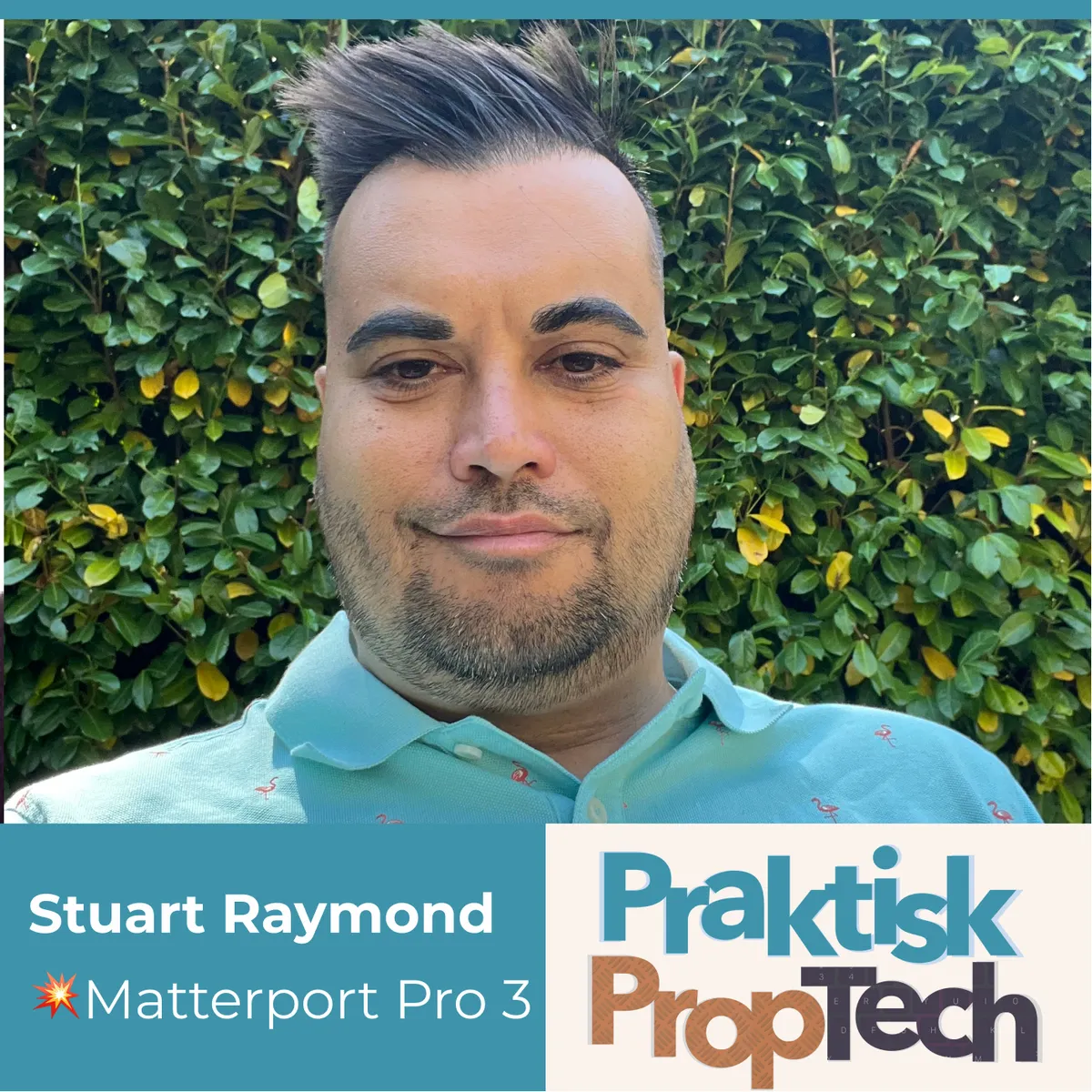
So today it’s a very special episode. We have really found one of the most technical companies out there that are doing something really disruptive. And today’s episode is about Matterport, and we will talk about the new Pro3, the newest camera for making a digital twin. And to help us with that, I have managed to get Stuart Raymond from the UK, Senior Channel Account Manager in Matterport. Welcome, Stuart.
Stuart 01:00
Hi, Tommy. Great to be here.
Tommy 01:03
How is life for you at the moment, just after the release of the Pro3?
Stuart 01:09
So, Tommy, first of all, thanks a lot. As I say, it’s great to be here and talk to your listeners as well. Really excited to be here. I think with the launch of the Pro3, it’s really taking us to the next level. Really, really excited. And I know you’re one of the first partners to actually have and try the Pro3.
Talking about it offline, I know that you’ve explained about some of the great capabilities that it offers. The fact that it’s now a LiDAR scanner. The fact that you can scan outside, it’s better accuracy, quicker, et cetera, et cetera. So absolutely thrilled to be here and just let your audience know a little bit about Matterport, and a little bit more about where we’re going in the future.
Tommy 01:51
I think we have to build up the Pro3, even though I will say that the Pro3 is like something out of this world. But let us come back to that and …
Stuart 02:03
Sure.
Tommy 02:03
… go specifically into the Pro3. But before that, can you tell us about who is Stuart and who is Matterport? And you are responsible for the Nordic countries from Matterport, is that right?
Stuart 02:16
Yeah, absolutely. So my role at Matterport is really to look after our strategic resellers, such as yourself, and I look after the Nordic market at the moment. So my job is to work closely with you, partner with you, and do activities such as this, where we can really communicate and articulate the value of Matterport and our hardware and software products. So I’ve been working with you for around a year now, and as I say, it’s great to have this opportunity to have a Norwegian audience understand a little bit more about our products.
So yeah, I’m based in London, and I’ve been promising that I’ll come over to Oslo, and I will do that at some point, and we can do some joint scanning. As you know, Tommy, it’s very user intuitive, very user-friendly. Even I’ve had a go at it, and I’ve been successful. So it’s all good here.
Tommy 03:10
I think if we have any listeners having an advanced building and the need to have expert help, I think that’s the date you will come to Oslo, isn’t that right?
Stuart 03:19
Yeah, I’ll probably look at you, Tommy. I think you use it more on a day-to-day basis than I do, and you’re more of an expert, I think, in the nitty-gritty. So happy to support, but I think your clients will be in good hands with yourself.
Hvordan har reisen til Matterport vært
Tommy 03:33
So Matterport is a massive, massive company from the US. It’s publicly traded now. So how has the growth … How has the journey been for Matterport? Being a disruptive company coming up, and now one of the really, really big ones.
Stuart 03:52
Yeah, exactly, and that’s a really good point, Tommy. As you rightly say, last year we went public. We’ve really grown. So Matterport started out in 2011, as you say, as a disruptor, really coming into the market and taking it by storm. Our flagship product at that time was the Pro2, and the first industry that we really targeted was around real estate. We’ve grown significantly since then, as you know, and not only have we grown within the US, we’re now really significant in Asia and Europe. And we work with a number of reseller partners, such as yourselves, that are really the extended sales arm of Matterport, if you like, and really telling the story beyond that.
We now look at architecture, engineering, construction, facilities management, insurance, retail, travel and hospitality, photography; it really works in so many sectors. And the objective of Matterport, as you rightly know, Tommy, is really to transform the built world. Really digitalize it, really give users the opportunity to capture, not only to make it appealing on the eye, which obviously it does, it’s great for that, but ultimately, the objective is to serve a purpose. Is it to improve efficiency? Is it to save costs? Is it to generate revenue? They’re really the three reasons why Matterport is key.
And it’s all about data. You’ll know as part of your business, and I think most of your listeners will get it. It’s the projects; they really need to understand data in greater detail, and that’s exactly what Matterport can offer.
Pro2 kamera og software, hva kan man gjøre med modellen?
Tommy 05:30
Very, very good. We actually have a few episodes in Practical PropTech where we have talked to listeners and users of Matterport, and they have described that they actually found more square meters in the building. They have cut down on travel cost. They have done very massive things with the camera that I didn’t think about at the time, and I really want to go back on that at the end: What have you seen out in the world? How are people using it?
But for the people that haven’t used Matterport and don’t know what it is: Matterport is a software and a hardware part, right? So can you tell us more about … We have talked about that the Pro2 is the flagship. That’s a camera. It’s a very, very good camera with 134 megapixels.
Stuart 06:20
Sure.
Tommy 06:20
And it’s scanning around for 20 seconds to actually make a digital twin. Can you tell us more about the Pro2, and also a bit about the Pro3 that I just got?
Stuart 06:29
Yeah, absolutely. So I’ll just go back into a little bit about how we position ourselves, Tommy. So absolutely, we have the hardware element, which is the Pro2, the Pro3, and Axis, which I can talk briefly about. But essentially, software is a huge part of our offering, and services. So capture services is something that we offer. Won’t cover it on today’s podcast, maybe that’s one for another time, but if anyone’s interested, it’s essentially where we have people like yourself, Tommy, that are trained technicians that can go and capture spaces on behalf of clients, that may be more complex, or that people don’t have the time or the resource to do. So if anyone’s interested in that, they can certainly come to you.
But just to go back to the hardware side of things: as I say, I’ll talk about the Pro2 and Pro3, but from a software point of view, I think most people are used to using software as a service. Essentially, when a customer makes a capture, they have the opportunity to upload it into the cloud. That’s essentially what it does in simple terms. Once it’s in the cloud, users have the opportunity to edit and enhance it in any way they want. We have a number of add-ons, whether it’s what we call the notes functionality, where people can write notes.
And one of the great things about that, Tommy, is that a lot of what we do is about collaboration. So if you and I were working on a project, I could put some notes in there. So we’re working on a technical project, an AEC-type project; I could put some notes in there that I want you to review. You would be able to collaborate at the same time, look into the model and add notes. You’ve got the tags that you can put in, floor plans, et cetera, et cetera. So I’d urge your listeners to contact you or have a little look, Google the add-ons for Matterport, because it really develops, and it can become really rich data at the end of the day.
We also work with platform partners as well, such as SimLab, that can add the rich data. For example, if you’re looking at a particular house, I saw an example where you can see the image with lamps on, lamps off, and how that looks, and the data just becoming greater and greater. So yeah, that’s really from the software point of view.
The Pro2, as I said, has been our flagship product for a while. And it serves the number of industries that I’ve mentioned, really: real estate, commercial real estate, facilities management, all those types of things, and really offers a full 3D capture. It includes unlimited 4K print quality and really that 3D accuracy. Again, it’s all about the reason why you do it. It needs to serve a purpose. That’s about collaboration, it’s about data, it’s about project. Like you say, some of your clients said to you, it saves costs. Really, really important.
You’ve mentioned how quick it is to capture, the accuracy of it. It’s actually essentially an infrared product. And one of the things that surprises me is how many people are interested in the fact that it’s got an 8-hour battery life. As small as that feature is, it’s important when you’re out there, right? You need to have that reliability. And there’s still a place for it, Tommy …
Tommy 09:40
I …
Stuart 09:40
… it’s not changing. The Pro2, there’s still a place in the market. The Pro3 isn’t replacing that; it’s a complementary or additional product. Sorry, you were going to ask a question?
Forskjell på Pro2 og Pro3
Tommy 09:50
I think if we look at the Pro2 today, we have been using it since 2019, and it is a great camera for indoor scanning. It’s so easy. You take it up, you turn it on, it will have a battery time of 8 hours, and you basically take a picture. Then you move it, take a new picture, then you take a new picture, and everything is matched together.
And I remember the first time I was trying to scan something at home, I was trying to scan my outdoor area in the direct sunlight, and I think that’s where we see the weakness of Pro2. It’s an indoor 3D scan camera. It doesn’t have the longest range. So when …
Stuart 10:33
Sure.
Tommy 10:33
… going into big buildings with 12 meters roof height, then you will maybe see a problem with the Pro2. And then for me, that’s when the Pro3 is coming in, because the Pro3, you can actually scan 100 meters at a time.
Stuart 10:48
Yes.
Tommy 10:48
And you can actually scan outside in direct sunlight, and it’s even quicker. The only bad thing is, and I don’t think it’s a bad thing, because you have changeable battery, but it will use more battery, right? Because of the new technology …
Stuart 11:02
Yeah.
Tommy 11:02
… that you have in it.
Stuart 11:04
That’s it.
Tommy 11:04
Yeah.
Stuart 11:04
Yeah. Yeah.
Pro3
Tommy 11:05
So tell us more about the journey with Pro3. What’s the upgrade, and how are you presenting that product compared to the Pro2?
Stuart 11:15
Yeah, absolutely. It’s a really good question, Tommy. And you’re right, so it’s very much a different product offering than the Pro2. So just to be clear, that isn’t obsolete; it’s still out there, it’s still a great product. The Pro3, as you mentioned, I think the main difference is it’s a LiDAR scanner, so it’s not infrared. So that’s the first significant thing.
And what’s great about it is the pricing point. There are a lot of LiDAR laser scanners out there that are a lot more expensive. Absolutely, they do a great job, and we always say: there’s a right tool for the right job, and 99 percent of the jobs out there, we believe the Pro3 could serve. Absolutely, when you need even more accuracy, it might not be the right tool. Let’s be honest about it. But for the majority of projects out there, it will serve.
So LiDAR camera: as you say, it’s got the capability of being outside. That’s a great enhancement there, because, as you said, the Pro2 is really aimed at indoor. But with this enhancement, we have that. Faster scans; the captures, as you said, up to 100 meters. I think it’s 20 seconds now per scan, so it’s improved. And it’s lightweight, user-intuitive, just like the Pro2. Like you said, Tommy, when we were talking offline earlier, it’s really a case of people maybe looking at YouTube, just looking at Matterport Academy, or speaking to yourself, just having a bit of a chat to really understand how to do that. And again, if people are uncomfortable, I’m sure Energy Control have that service where you can go and scan for people, so that’s always there as well.
It is a lot faster, and it processes a lot quicker as well. So it’s really aimed, I’d say, probably to suit the AEC-type market, where you really need those detailed projects, whereas the Pro2 might be a bit stronger for the real estate, photography space. But there’s no reason why you can’t use the Pro3 as well. So hopefully that’s enough of a teaser, but I think your clients should get in touch with you to learn more about it, but it’s absolutely something worth looking at.
Tommy 13:12
We have, of course, the Pro3 at PropTech Bergen, and trying it out every day, giving it new challenges, and I have to say, it’s an amazing product. I was really, really surprised. I was expecting a small upgrade or something, but for me it was a very, very big upgrade. And it’s so small as well.
Stuart 13:34
Yeah.
Tommy 13:34
I can take it with me traveling without checking it in.
Stuart 13:38
Yeah. Exactly.
Tommy 13:39
And you also mentioned something about the accuracy. So the Pro2 has a 99 percent accuracy. The Pro3, if I remember, is 99.3 percent accuracy, right?
Stuart 13:49
Yeah. Yeah, yeah.
Tommy 13:49
So it is an increase of accuracy as well.
Stuart 13:52
Absolutely.
Tommy 13:52
But maybe not the 99.9 that we are seeing on some of the very, very expensive LiDAR cameras out there.
Stuart 14:01
Yeah, and that’s absolutely a valid point, and there are some cases where you’re gonna need that absolute precision. And that’s where maybe a different tool, one of the bigger scanners out there, might be more appropriate. We accept that, because we believe we’re very unique in this space, and we don’t really have the competitors. If you need that absolute precision, then it’s maybe a different scanner. But, as we say, for 99 percent of the jobs, the Pro2 or Pro3 should do it.
And, of course, you have Axis as well. If you’ve got any listeners that are quite new to scanning, or in photography and may be using it for leisure or just wanna start out, that might be a good point. But when you need to get into the real specifics of a project, and you need that really detailed visualization and data, that’s when the Pro2 and Pro3 come into their own.
Tommy 14:50
I always believe in companies saying: “It will not be for 100 percent, but it will be for 99, because that’s the simple way to solve it.” And as you …
Stuart 14:59
Yeah.
Tommy 14:59
… said it yourself, I think the software and the hardware combination that you have is something that is very unique for small, medium-sized buildings. And in my case, I think that in 100 percent of all of my buildings, the accuracy has been good enough. And I think that’s a very important part as well: What’s good enough?
Stuart 15:22
Absolutely.
Add on
Tommy 15:22
You also mentioned something about: you have a hardware, that’s the cameras; you have the software, which is the platform. You scan something, you upload it, it will become a 3D module. And I have seen for the last year that you have more and more plugins coming into the portal as well, because now you can actually get a 2D drawing of the building, the overview drawing. You can get a MatterPak, which is actually now also integrated into a system called Revit, which is very popular for the Norwegian listener.
Stuart 15:53
Absolutely, yeah.
Tommy 15:53
And you also have E57 files and BIM files.
Stuart 15:58
Yeah.
Tommy 15:58
So what’s happening with all of the Matterport extension modules?
Stuart 16:03
Yeah. So, you know what? As you’ve mentioned, Tommy, we’ve got a number of add-ons, if you like, that we work with Revit or any of the other software partners. And we’re gonna look to continue to listen to what the market needs and evolve. I think if we’re looking at the future, at the moment it’s really around collaboration, which I mentioned earlier. That’s our big focus: really looking in the future to continue to provide solutions that help with collaboration, that help with accuracy. The data has got to be second to none.
And with all of these, the Revit, the E57s, they’re there to really help the people that are managing the project, give them that absolute precision they need to manage that project and be successful with it. And that’s where we’re really looking for, not only for Matterport with our resellers, such as yourselves, and also our platform partners in the future.
What I will say, maybe for another day, it may be worth exploring how, alongside yourself, we work with some of our platform partners that really provide the rich data. There’s some really exciting things out there, and maybe if there’s demand from your audience, we can get one of those speakers in to tell us more about that.
Casestudies
Tommy 17:17
Nice. Nice. I think this is very, very exciting news for the Norwegian market, and I know that we have some really diehard Matterport fans out there for our listeners as well. And to go practical, down to the value that you create, because that’s, I think, what our listeners have been really about: technology is fun, but why do we do it? What’s the point?
Stuart 17:40
Yes.
Tommy 17:40
And when I’m going into matterport.com and look at the case studies that you have, you have some unbelievable case studies. JLL has reduced transaction time by 85 percent. You have shopping malls that have increased the revenue …
Stuart 17:57
Oh, yeah.
Tommy 17:57
… when scanning and putting it online. You have Arup, you have Gilbane. You have so many exciting use cases. Can you tell us what’s your favorite use case of using your product?
Stuart 18:09
There’s so many to pick from, Tommy. You’re right, it’s becoming more and more creative. The education sector is used a lot more now. Or, if you like, you used your example of retail: I think one of the things that fascinates me is having a customer that uses it for stock intake. And a coffee brand that uses it basically to make sure that consistency is there and that the branch or the store is meeting their requirements. So they’re using it for that sort of thing: take a capture and assess it every day. I mean, it’s just becoming more and more interesting. So they’re the sorts of things that really excite me; simple things like museums and churches, seeing that type of thing.
I mean, they’re fairly standard, but they still excite me, seeing those. And things are evolving. The rich data, as I say, is really the key, and I’m emphasizing that because that is gonna be the future, I believe. So yeah, I would urge your listeners to have a look on our website and see some of the really cool case studies we’ve got out there, just for inspiration. If not, obviously, you can share it with them as well.
Tommy 19:14
I have an experience. Now, I’m maybe more of a diehard fan, but when I ordered a hotel in Estonia, and when I was doing my research, there was one hotel that actually had a public Matterport 3D module of the hotel, and of course …
Stuart 19:32
Right.
Tommy 19:32
… that’s where I ordered.
Stuart 19:34
Yeah.
Tommy 19:34
So I can understand that hotels are seeing increased revenue, because when you do the research, you can actually see your hotel room. You get more confident that this is a nice place to be.
Stuart 19:46
Oh, yeah.
Tommy 19:46
And there are so many things surprising me every day of the use cases of this.
Stuart 19:52
Yeah, and that’s a really good example, Tommy. You’re right, because, like most people, I really enjoy traveling. When I get the chance, take leave, I will always look for the best imagery, the best tours I can see. I really want to understand and kind of experience it.
Another really good example, actually, you just reminded me of, is restaurants. We’ve had use cases where people literally capture the seating arrangements, so people can go in and actually book where they want to sit based on the capture they’ve seen. I might say, “Okay, I’m meeting Tommy for a business lunch. I want that table by the window, next to the stairs,” or whatever it may be. So it can be used in whatever wacky way that you want. But you’re right, people are using that to really make informed decisions.
What’s the next move
Tommy 20:37
Very, very cool. And just a final question that I have to ask, I don’t know if you can’t answer it, but we are seeing customers like DNB, which is a property owner, really using Matterport to store all of the documentation of the building. They are putting in all of the sensors. We have a great project now in Bergen, where we have like 1,000 Mattertags now with all of the documentation and data. Where do you see Matterport in the future? What’s the next step for you guys? What’s the next disruptive move?
Stuart 21:06
Oh, I think you have to watch this space, Tommy. But the one thing I will say, as I’ve mentioned throughout the interview, really is around giving more data, giving better data, improving the data, rich data. They’re the sorts of things that we’re really looking to do. But I think let’s watch this space and see what happens next year. I think let’s let the Pro3 work its magic first, and then we can start looking at the next exciting projects.
Tommy 21:32
So if people want to order the Pro3, I know there’s a big demand at the moment, so when is the earliest you can ship to Norway, to PropTech Bergen, if somebody wants some?
Stuart 21:43
I would say at the moment, there’s probably between a three- and four-week waiting time, Tommy, just purely because of demand.
Tommy 21:49
Okay.
Stuart 21:49
So I would urge, if anyone’s interested, to place an order through yourself and get it in quickly, because the sooner we get the orders in, the sooner we can ship them out. But no surprise, as we were talking earlier, there is huge demand across Europe at the moment. So yeah, we’re building them as quickly as we can. But yeah …
Tommy 22:07
Yeah.
Stuart 22:07
… look forward to seeing a lot more of them in Norway.
Tommy 22:09
Sounds very good, and I will also take you up on the word of you coming to Oslo next time we do a job.
Stuart 22:16
Absolutely. And we’ll book that restaurant via a capture that I’ve seen.
Tommy 22:22
Perfect. Thank you so much for joining us today on Practical PropTech, Stuart, and hope to see you very soon in Oslo.
Stuart 22:29
Brilliant, Tommy. Thanks so much for your time. I’ve really enjoyed talking to your listeners.