Tommy 00:01
Welcome to Practical PropTech.
Martin 00:03
With Martin and Tommy.
Tommy 00:05
This is not a podcast where we’ll talk about the future far, far away.
Martin 00:09
But rather how new technology can help us operate,
Tommy 00:12
maintain
Martin 00:12
and use our buildings smarter today.
Tommy 00:15
We will discuss the best example from Norway
Martin 00:18
and from abroad
Tommy 00:19
on how sensors, technology and buildings connect together. So let’s go!
Martin 00:26
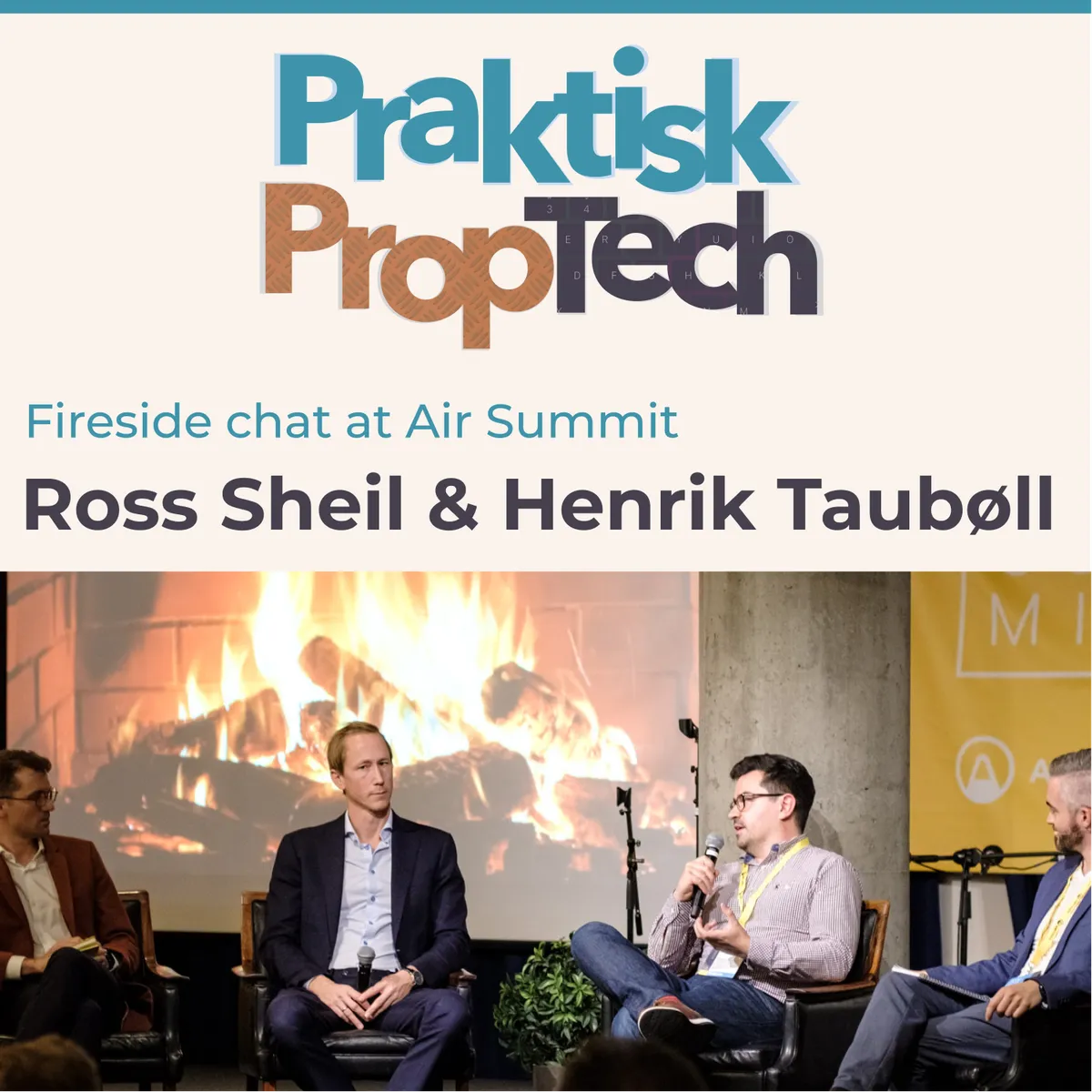
Welcome to another episode of Praktisk PropTech. We’re coming from you live in Oslo at det Gamle Museet, where we’re at the Air Summit, hosted by Airthings today. And we’re joined by some very special guests to discuss a full day full of property technology and air quality. But we’re especially delighted to be in front of an audience, a live audience, so probably some of the die-hard fans of the Praktisk PropTech podcast. So many in the audience here today that’s been listening to Praktisk PropTech? Wow! And even better than an enthusiastic audience like this, Tommy, we have some great guests with us today.
Tommy 01:07
Yes, for sure.
Martin 01:09
And so we have from Proptech Norway, community builder, and I know your favorite WhatsApp group, thanks to Henrik here as well. We have Henrik Taubøll, founder of Proptech Norway. He’s a lawyer in Wiersholm, formerly from WeWork Nordic, responsible for Nordic expansion, and just the most ihuga property technology fan I’ve ever met. Certain words you can’t translate.
We also have the honor, as a half Norwegian, half Irishman, I’m very honored to have a true Irishman on stage with us. So Ross Sheil, VP in Infogrid. He’s formerly been in both the technology companies, Twitter and my especially favorite Irish scale-up, Stripe. So it’s an honor to have you both here with us today.
Tommy 02:02
So …
Martin 02:02
Shall we give them an applause as well?
What was the most important data for Henrik in his time in WeWork?
Tommy 02:08
The first question today, Henrik, goes to you, because you had this very good keynote. You opened the event today, and you shared some very interesting insight about your previous role in WeWork and all of the data you collected in all of these buildings. What data did you find most interesting of all of those?
Henrik 02:29
Well, I think the most interesting part was that you don’t just trust data that you haven’t really qualified and checked. They did a lot of big surveys with large respondent groups, but then they counter-tested it with technology. So when they asked people: “What kind of break areas do you like?” people said: “Well, I want the lounge, I want the fireplace, and I want the big chair to sit in.” And when we tested with the heat-seeking cameras, people actually took all their breaks in the kitchen areas, and that’s why they built the kitchen areas.
But the approach that I liked was that you got an answer, and then you tested it, and then you know the facts, and then why people went to the coffee and the kitchen area, that’s not that relevant. If you know that it is how people move, and that you always counter-tested everything with real facts.
Tommy 03:25
That’s impressive. So they actually measured where people were working, where they sat, how long they sat, and almost everything about the people in the building?
Henrik 03:36
Yeah. So this kind of contradicts some of your beliefs, but they had a lot of sensors everywhere in the building. But then they found out: if no one’s actually going through that data and analyzing that data, what’s the point of having these data points then? So what they did was they scaled back a lot of the sensors, and then they said: “Well, let’s find out what break areas people want, or how does the width of the hallway affect how many friendships are in the building?”
And they do specific buildings, specific groups, target groups, and then they tested this hypothesis, and then they found these kind of findings, like a specific width of the hallway would make the likelihood of people becoming friends in the building 1.5 times greater. And this is because, you think it’s because they say hi if it’s a certain width, and if it’s too wide, people avoid each other. Too small, then it’s uncomfortable. But the point is that they tested it on such a big data set, so they knew it was statistically significant. And yeah, that’s …
Tommy 04:41
… where you get the value of the data, really. Very, very interesting.
What problem does Infogrid solve for customers today?
Martin 04:46
And a company that’s definitely as curious about data as we were, was of course Infogrid. And Ross, you had a presentation earlier today, highlighting the tremendous growth journey you guys have been through with the IoT platform, which is Infogrid. I remember meeting Will, the CEO of Infogrid, probably less than two, three years ago, and there were maybe 10 people working in Infogrid. Today, you’ve crossed 100?
Ross 05:16
That’s right. 100 folks, and growing now.
Martin 05:19
So it’s a hyper-scaling global company already. What problem does Infogrid solve, which is so attractive to building owners?
Ross 05:30
Fundamentally, we exist to stop climate change in the built environment. And as I touched on today, carbon emissions from commercial real estate account for about 39 percent of all emissions globally. I think we’re in a space now where every business in the world understands the ESG agenda, but getting them to a point where they will actually invest in it also requires alignment with their business initiatives. And how Infogrid approaches that is through a smart building platform with applications for healthy buildings and for smart maintenance, where there’s very clear business benefits that impact the bottom line.
As an example, a remote Legionella solution that removes the requirement for manual testing, and can be managed remotely through machine learning out of a dashboard. It produces an ROI for a client, but has a very clear ESG impact as well. And I think from an Infogrid point of view, we believe it’s important to approach the climate change agenda in that way, where it’s a clear painkiller for businesses in terms of what it focuses on day-to-day around commercial real estate, but has immediate upside from an ESG point of view simultaneously.
How was Ross transition from Tech into Prop?
Martin 06:43
I think your transition into Infogrid, ’cause you’ve formerly worked for two technology behemoths, both Twitter and Stripe, and recently joined now the prop world, and it’s a similar transition I’ve been through myself. And one of the themes I’d like us to just explore today is this: the tech into prop and that transition, where we’re seeing software developers, technologists coming in and at times getting a little bit shocked at what they’re seeing with our buildings.
I remember the first time I saw Tommy program a building. And I asked him: “So what about the peer review? Does anyone review your code before you deploy it?” “No.” There’s no unit test or automated quality assurance, and when he deployed, it was just deployed straight into production, no test environment. And you looked at me a bit curiously when I asked you about object-oriented programming.
Tommy 07:33
I’m that good. That’s … No. But I mean, Ross, for you, coming from your background with a techie background, going into what you talked about today, the black hole of buildings, how was that transition for you?
Ross 07:49
Yeah, it’s an interesting one. I think, look, the folks in commercial real estate who are managing buildings day to day and on the ground, I really love the industry. They’re fundamentally problem solvers. They think about these problems from a first principles point of view. But I think generally, they’re underserved with tools and platforms from a digital perspective that can help them to get the job done. And I think we’re in a space now where that education from a digital point of view, particularly in facilities management and any aspect of commercial real estate, is top of mind.
And we don’t design products in an ivory tower from an Infogrid point of view. We really think about the end user of the product. So examples of that would be from a cold storage point of view. We worked with the NHS during coronavirus on storage of coronavirus medicine that needs to be stored at a specific temperature. And whilst we were developing the software for that product, working in lockstep with nurses on the ground to understand what would they actually need in the product to use it in a simplistic way, what would the alert system look like? And we built this really simple tool that is able to collect historical data in an automated way around cold storage, and also an alert system that alerts nurses when that is out of range, right?
And that’s generally when we think of all of our applications, we think about the ultimate end user of the products. Is that a cleaner? Is it somebody in a workplace team? Is it a nurse that’s managing cold storage medicine? I think that’s important in an industry that is yet to experience digital transformation, yet to experience robust digital transformation, right? That digital transformation is occurring, but you have to remember, it’s tech for non-technical, fundamentally, right? So if you start to articulate aspects of your product around machine learning or artificial intelligence, or talk about radio frequencies of IoT, you’re just gonna lose these people. They won’t get the day-to-day problems that it can solve from a buildings point of view.
Martin 10:04
You’re making the distinction there between … And we’ve done a lot of lip service to digitalization. I think most industries have talked about digitalization the last few years, but how do you differentiate with robust digitalization? Why did you correct yourself there?
Ross 10:19
’Cause if you look at the commercial real estate industry, I think there has been, there’s like 1.0, 2.0, 3.0. I think we’ve probably been through 1.0, right? The first version of smart analytics, the first version of occupancy-oriented solutions that give you that upper funnel view on data points around a building. But to actually get to mid-funnel data, lower funnel data, and then recommendations as to what’s taking place in a building, where you’re able to derive meaningful insights and actions from multiple data sets, that system of systems that we spoke about earlier today. I think that system of systems where the whole is greater than the sum of all parts is starting to become a reality. But two years ago, three years ago, four years ago, it wasn’t. It was just more basic data points.
Martin 11:17
Just going, the initial wave of digitalization was that you have all these raw data points being collated, and at least you have that in a digital framework rather than a physical piece of paper.
Ross 11:27
Yeah.
Martin 11:27
You mentioned Legionella, because Legionella compliance is traditionally a very manual, paper-based process that’s been digitalized.
Ross 11:38
Indeed, right? And everybody in this room has a building, is involved in the commercial real estate industry, and has probably experienced this kind of behavior in different aspects of the building. But across lots of use cases, whether it’s emergency lighting, electricity monitoring or Legionella, you go into a building, and a lot of maintenance teams are still writing with pencil and paper in a workbook and recording data in that way, storing it securely on-site. Moving from a world where folks are doing that to a world where it’s managed remotely and centrally, and to the point on helping these people with tools, you abstract away the need for that manual work, where they can just look at it in a dashboard and then focus on the most at-risk locations where Legionella is likely to be a factor.
What does Henrik sees from the transition from Oil to building?
Martin 12:27
And one area where it’s not very convenient to have a piece of paper and run around to Mark’s office, on an oil platform. And Henrik, you mentioned in your presentation earlier today this cross-fertilization we’re seeing now, particularly with the previous downturn in the oil industry, and these technologists that might have gotten a similar shock I got when I saw how our buildings are programmed, when they transition from an oil career into our building industry. Can you recount some of those experiences and maybe some good examples of how that’s been a beneficial cross-fertilization?
Henrik 13:02
Yeah, definitely. I think this is a general trend, but to have a lot more personal example, one of my good friends worked as a pipeline engineer in the North Sea, working with oil platforms. And in the oil dip in 2016, he lost his job, and he looked for new work, and he started in the real estate industry. And these guys were using, 2015, 2016, AR glasses, BIM models. They had everything rigged on these pipelines going into the North Sea. Of course, it was really, really high tech, and he started in this construction company, and he got everything on paper, and like: “Here’s a pencil, and you can draw the changes on this map.”
And he was shocked. He was shocked that everything he learned in five, six years in the oil and gas industry, nothing was implemented in the real estate industry. And his frustration was: it’s already there. The technology is there. You call it oil and gas, but it’s really a tech industry, and they might as well go over to real estate. And a lot of the other successful PropTech founders in Norway are people coming out of this oil and gas tech segment. Or they are getting good resources from this industry, where people are transitioning into real estate and other solutions.
So I think Norway has kind of an edge on the high knowledge on how to build things. Okay, if you go build a super advanced oil platform in the North Sea that should withstand storms and everything, and then have pipelines on the seabed, then you can erect a building or an apartment block in Norway as well. But you can take some of that learnings and some of the technology and use it in real estate, and I think that’s been hugely beneficial for us.
Martin 14:54
And not only in the construction. I know, Tommy, now you 3D model in the maintenance of buildings. It wasn’t just for fun that we 3D modeled today, was it?
Tommy 15:04
No, it’s never for fun, Martin. It’s always for …
Martin 15:06
Deadly serious.
Tommy 15:08
… for pleasure. But I also feel like there is another transition as well, just to defend my fellow props out there. I think many property people have also been quite shocked by all of the IoT companies coming in and want to control the air, want to deliver the best sensor for the air, and then they’ve never seen a ventilation system. And that’s also, for me, very interesting, and I think that’s the reason why me and Martin is the duo, because we see that PropTech is not only about technology, it’s also about people collaborating, working together. The property expertise together with the tech expertise is maybe the best of the future, and maybe oil and gas as well, and more people into the industry. And I think that’s also very important for us, to see how can property technology be inclusive, Martin?
Martin 15:58
Of course it is.
Martin has brought his favorite picture of Arild, but who is he?
Tommy 15:59
Do you have your favorite picture?
Martin 16:00
That’s why I have my favorite photo here with me. And no, Tommy, it’s not my mom. Whenever we record an episode, we have this picture in front of us, and this is Arild. He’s a building operation manager on the west coast of Norway. He has 60 buildings, 55,000 square meters of property he manages. He’s not the most technically savvy, and I think even though I get really excited hearing Ross talking about artificial IoT and machine learning, I’m not sure if necessarily it would be the most exciting things for Arild, or he wouldn’t necessarily feel included in that journey.
So one of the challenges … I’ll just put him here so he can kind of be here with us. I think the second theme to discuss is how do we make this transition we’re going through, this robust digitalization we’re going through, how do we make it inclusive?
Henrik had a slide “If we are able to use the insight”, what did he mean?
Tommy 16:52
I think also if we look at your slide today, Henrik, you had one of your slides saying: “Are we able to use the insight?” And I think that’s a question me and Martin is asking ourselves every day. And do you have any experience in WeWork, did the janitor, did the site manager actually use all of the insight?
Henrik 17:12
Yeah, definitely. And now it seems like I’m only pro WeWork, and there’s both sides to this coin. But some of the things that they really did well, and what I tried to take away from it, was kind of what you’ve seen on NRK, on the documentary about Adam Neumann. You can say a lot of things about him, but they made kind of a culture that people would be included in. And one of his points was that everyone should be hired in-house, and everyone should be part of the same team. And everyone that cleaned, everyone that did maintenance had the WeWork T-shirt on, and the same T-shirt as the community manager, the same T-shirt as the directors.
So everyone was kind of in the same team, and then they used a lot of these gamifications, where different regions in different parts of the world competed, really. So in Berlin, where I was every Monday, they had a response time, when someone complained about something, at 1 minute and 20 seconds or something. And why did they get these maintenance people to respond this quickly? Well, because they were competing against the other countries, and they tracked, and they had this competition on who was the fastest to respond to every inquiry.
And at the same time, they were part of the team, so they were encouraged to use the data. They were part of kind of a product, and other of these departments had presentations that were included, so everyone was on the same page. And I think to get an understanding for everyone would be good. Like, is to really explain why it’s beneficial for them and why it makes the job easier and more fun. I think that’s the human side of it, but I think it’s hugely important.
Tommy 18:56
I think I also heard that on Huava’s presentation today, he said that one of the key points was to get the maintenance department on board with the IT solution.
Henrik 19:08
Yeah, I think that’s right. That’s exactly kind of what we wanted to … They were included. They knew why it would work. When new products were introduced, they tested it first. They were included in: “Should we buy this? Should we not? What do you think?” And kind of that inclusiveness made at least people feel like they were part of the process, and then it was easier to use because they’d been part of really purchasing this product and recommending it. So, yeah.
How does Ross get the janitor and site manager up and running with IoT?
Martin 19:35
And Ross, how do you think about product development in Infogrid to make it as easy and addictive to tweet as to manage your building?
Ross 19:46
I think that’s a good question. Look, there’s this kind of litmus test around time to wow, but what is the wow moment for the persona which you’re developing your product for? And ultimately, you’ll have multiple personas, right? If we built a product solely for the management layer of a building, and that was the best product in the world, but yet it did not have the utility, functionality or feature set for frontline workers who are at the coalface of what we’re trying to do, we would not be successful, right? We need to make sure that we have a product for all personas, the ultimate end users of the product, users of the product that may be looking at the data from a management and analytics perspective, or from a leadership point of view.
And our product development methodology is very bottoms up. So we start from a position of ignorance around: okay, what would a cleaner want in a smart cleaning solution? If we were to make their time more productive in this building, what’s the first thing we could do for that cleaner? Well, maybe it’s some kind of digital twin-type functionality that’s color-coded. Maybe there’s complexity in that particular frontline worker set around languages. I mean, if you look at a market in London, sometimes you’ll get cleaners that do not have English as a native language, right? If you go to somewhere like Singapore, you also might get native speakers that just speak Chinese, as an example, and they don’t speak English.
So these subtle things in the product and nuances in the product need to be oriented towards usability, right? So what we do in the smart cleaning aspect, as an example, is just give a very simple color-coded floor plan to a cleaner so they can see: “Okay, I know that this area here wasn’t used today. This area was used today, and I should spend more time here than there.” It’s just these simple things that help these folks have more productivity, more usability of the product. Because ultimately, that’s one of the stakeholders that we serve and one of our biggest constituents.
Martin 22:08
I think that approach to product development, the user-centric approach to product development, is probably also something that this transition from tech to prop, that’s where we’re really like, how do we design … Well, if you look at most social media companies, they’re addictive. You were saying you gamify things in WeWork. You’re being really user-centric. How do we take what’s been successful on these technology platforms, and we bring them into property? And I think we’re going to see a lot more enjoyable and less frustrating user interfaces in our building management systems going forward. Right, Tommy?
Tommy 22:43
Probably.
Martin 22:44
Probably.
What ESG technology does Henrik really believe in?
Tommy 22:44
But I think also the last theme of the night is also we need to talk about sustainability. I think also that’s a very important way to look at …
Martin 22:56
Yeah, Ross was mentioning in your presentation that 39 percent of our carbon emissions in Europe are due to our built environment, and … You had a, well, you quote, okay, Tommy likes this when other people quote him in a presentation, but you quoted Tommy’s study of Norwegian energy usage in the week before and the week after Norway shut down due to COVID-19. And the results, you can say your own study, Tommy. What was the result of the study?
Tommy 23:21
I like when you tell it, tell my … So I think, to see that when Norway shut down and all of the buildings were empty, that we didn’t save energy. So I really believe that PropTech is the enabler for sustainable building.
Martin 23:35
And why didn’t we save? What does that mean, that we didn’t save any energy?
Tommy 23:38
Well, we didn’t shut them down. We didn’t. So it was March, right? It was heating season. And we still had the same temperature, the ventilation system was still on, everything was running like normal. And I think that’s one of the biggest mistakes that we saw. Like, we didn’t … It was 2020, and we didn’t pass the test. What we have been doing for the last 40 years is not good enough. And that’s something that I think about a lot, that PropTech has to solve this. PropTech needs to be the solution for sustainable buildings. And Henrik, do you see any technology out there, PropTech technology, that will really be one of the big changes for ESG?
Henrik 24:25
Well, I’m also a member of the jury for the European PropTech House, and they are sitting on EU funding. So the winners get funding from the EU, and one of the focuses for the EU is to provide sustainable solutions, of course. In the finals, 10 companies pitched, and I felt like I was in an environmental conference, because everyone had the five minutes about sustainability and then the three minutes about their product. And I think, yeah, everything is going that way. But what I’ve been saying since the beginning is, for me, PropTech is kind of sustainability.
So energy saving, obvious one. But take a building with a co-working space, you utilize existing space in a better way. More people use it, so it’s more beneficial use of the building. Almost all these products are enabling sustainability. And then one thing with ESG, if you combine with that, is that the EU now sets these standards for real estate owners in terms of the financing, that the building and portfolio will be green, because everyone said that it’s green, and now they have to document it. And I think for PropTech companies as well, they will, because now the real estate owners are actually going through and finding out whether or not their portfolio is green, and they will be much more strict with the numbers and the data with the PropTech companies they invest in as well. Like, they really want real-time numbers and real-time sustainability goals to be achieved, and not just buzzwords like they have had previously in their portfolio as well.
So I think everything is pushing in that direction, and there’s a slight handicap, actually, for the PropTech companies that don’t really work in anything to do with sustainability, because there are also a lot of investment money going into it. I think a lot of the companies have a lot of money to invest in sustainability in general, and then they have some to invest in new tech with the ROI, and they’re like, it needs to have a return on investment. But the sustainability money is a much larger pot, and I think they will invest more in these PropTech companies that will help them achieve these sustainability goals.
What does Infogrid and Ross work in ESG goals?
Martin 26:43
But a company that showed some very impressive numbers when it comes to ESG earlier today in your presentation, Ross, is Infogrid. You’ve had some both on energy savings, carbon emissions reductions and water savings. Do you think, as Henrik is saying, we should rebrand PropTech, instead call it GreenTech? Is that really what we’re doing with property technology?
Ross 27:06
I think it depends on what part of the value chain, right? You have sectors of PropTech that are more PropTech/financial services disruptive. If you look at platforms like Settled or Nested, Stepladder in the UK. But then there’s very clearly a sector in PropTech whose macro goal is around ESG and sustainability. So there’s different terminologies that float around: clean tech, green tech, sustainability tech, climate tech, right? Kind of all talking about a comparable thing.
I think the point of friction for a lot of entrepreneurs, in terms of how they position their business, is likely around the market size, right? Where an entrepreneur probably wants to communicate to analysts like Gartner, or other analysts in their industry, that they sit in this specific sector that is growing. And I think we will arrive in a space where actually climate tech, or green tech or whatever that canonical terminology ends up being, is a big pull factor for a lot of entrepreneurs. They’ll want to be perceived as that, right?
But I still think, even though there’s such significant momentum behind climate tech, right, where it’s gonna be orders of magnitude bigger in five years’ time, and I think at that point you’ll see entrepreneurs and founders say: “I’m a climate tech startup.” They might not be saying: “I’m a PropTech startup.” Like, that’s a little bit opaque now for a lot of founders and entrepreneurs.
Henrik 28:47
And coming from the investment side, of course, I think people want to help out with the sustainability goals in general, but I think the most important realization for these huge companies is that financial risk and the sustainability risk is the same. So financial risk and sustainability is really the same. So if you have an unsustainable portfolio of real estate, it’s also a big financial risk for you getting funding, getting financing from the banks, everything. So I think when the sustainability goals are so specific as they are now, and they start really turning into the company’s finances, then it’s going to make a big shift for the industry.
Ross 29:35
Yeah, but you see that, just to build on your point, you see that with FTSE. The FTSE obligates TCFD disclosures around ESG and sustainability, right? And it’s advantageous for companies in their quarterly earnings reports to articulate what they’re doing around sustainability, ESG. The SEC is about to introduce the same legislation for NASDAQ-listed companies as well, so it’s definitely changing, evolving.
Tommy 30:05
I have a bonus question, because when we talk about sustainability, I also think that we need to … One of the key things we think we need to do with technology is also to save buildings, right? We can’t tear them down, we can’t do all of that, and one of my biggest fights has been to try to save a building, and we just did that, and that was because of PropTech, because we could do it differently. We didn’t do any cables. We could reuse all of the things that were there, and now we can use the best of PropTech to actually save it. And buildings in Norway, I think we are tearing down 22,000 every year. Do you see anything like that in the UK as well, Ross?
Ross 30:48
Well, I can tell you the buildings in the UK are probably not as nice as they are in Norway. So I’m sure it’s proportionate. And that counts into that 39 percent number, right? A lot of that 39 percent number does come from demolition. And it’s in our interest to make sure buildings last, right? We’ve managed to arrive at a point with electric vehicles where we have a sustained view on the life of an electric vehicle. But a building will last 10, 15 times, 20 times, maybe even longer than an electric vehicle, but still we have this kind of willingness to tear it down.
So I think from a regulatory and compliance, legislative point of view, that needs to be solved in that way, where there’s disincentives to do that, and ensure that we’re retrofitting green solutions to these buildings so that we can articulate that this building is sustainable and operates as well as any building that is built today in 2021.
Tommy 31:54
You probably see the same in the financial world, Henrik?
Henrik 31:57
Yes, definitely, and circular economy is really something that people want to work with. But in practice, as you’ve probably seen, it’s harder to do than you would think, because at WeWork as well, they were going to be carbon neutral by 2023, and that meant you had to reuse so much of the materials in the buildings. We got the new space, we asked the landlord. The landlord was a huge financial company or bank or something in that segment, and they said: “Well, we have the same goals. We want to be sustainable as well. We want to reuse.” And then we go into the building, and like: “Okay, can we reuse these roofing materials? And where are they from? We don’t have the CE numbers, and we don’t really know where they’re from.”
So there was no system for it, and we realized in practice, it’s so hard to do. And I’ve seen a lot of our clients as well working. They really want to reuse most materials, but it’s really hard when they don’t have the resources, the systems for it. So as a mentor at Antler as well, we saw a lot of these startups trying to tackle this space, and I think there’s gonna be a winner or two of the companies that really could make a system or a platform for reuse that actually could work and make things easier for real estate owners, definitely.
Martin 33:20
It’s getting quite hot in here. I don’t know if it’s the fireplace, or it’s the lack of beers in people’s hands. But I think with that wide-reaching summary of the day, we’ve sadly gotten to the end of another episode. Nok en episode. Another episode of Praktisk PropTech. Should we have some outro music, please, maestro? It is actually a children’s jingle. It is, yeah. And then, it’s another episode of Praktisk PropTech over. Thank you very much for joining us today.
Henrik 33:54
Thank you.
Martin 33:56
My name is Martin.
Ross 33:56
My name is Ross.
Henrik 33:57
My name is Henrik.
Tommy 33:59
My name is Tommy.
Martin 34:00
And you’ve just been listening to …
Henrik 34:02
Praktisk PropTech!
Ross 34:04
Praktisk PropTech!
Tommy 34:06
Praktisk PropTech!
Martin 34:06
Thank you. Okay.