Tommy 00:00
Velkommen til Praktisk PropTech,
Martin 00:03
med Martin og Tommy.
Tommy 00:05
Dette er en podkast der vi ikke skal snakke om en fremtid langt unna,
Martin 00:08
men hvordan ny teknologi kan hjelpe oss til å drifte,
Tommy 00:11
forvalte
Martin 00:12
og bruke byggene våre i dag.
Tommy 00:15
Vi vil vise deg de beste eksemplene fra innlandet
Martin 00:18
og fra utlandet,
Tommy 00:19
om hvordan sensorikk, teknologi og bygg henger sammen.
Martin 00:23
So let’s go!
Tommy 00:25
Martin, tåler ikke dere regn i Oslo? Hva er det som skjer for noe?
Martin 00:29
Det var ikke regn. Nei, det må være vann først. Det var vannrør i Møllergata som sprakk. Men det er også litt kult at Mesh Youngstorget nå har fått innebygd strømmesystem.
Tommy 00:43
Vi sender vår dypeste medfølelse, Anders.
Martin 00:46
Men det jeg synes er imponerende med både Anders og Daniel og resten av både Mesh og Proptech Norway, er at de allerede har funnet en ny plass for PropTech Summit 2023. Så frykt ikke, den blir ikke avlyst. Vi flytter til Mesh ved Nationaltheatret.
Tommy 01:03
Det symboliserer jo PropTech. Det er raske vendinger og løsningsorientert.
Martin 01:08
Innovasjon. Men ja, nå sitter vi her lørdag morgen ganske tidlig, og vi skal inn og møte en ganske hedersfylt gjest rett fra Nederland, nei, Belgia. Brussels.
Tommy 01:19
Han har reist siste året. Han reiste egentlig verden rundt og holdt foredrag. Han har pulsen på PropTech. Han spiser og snakker PropTech.
Martin 01:30
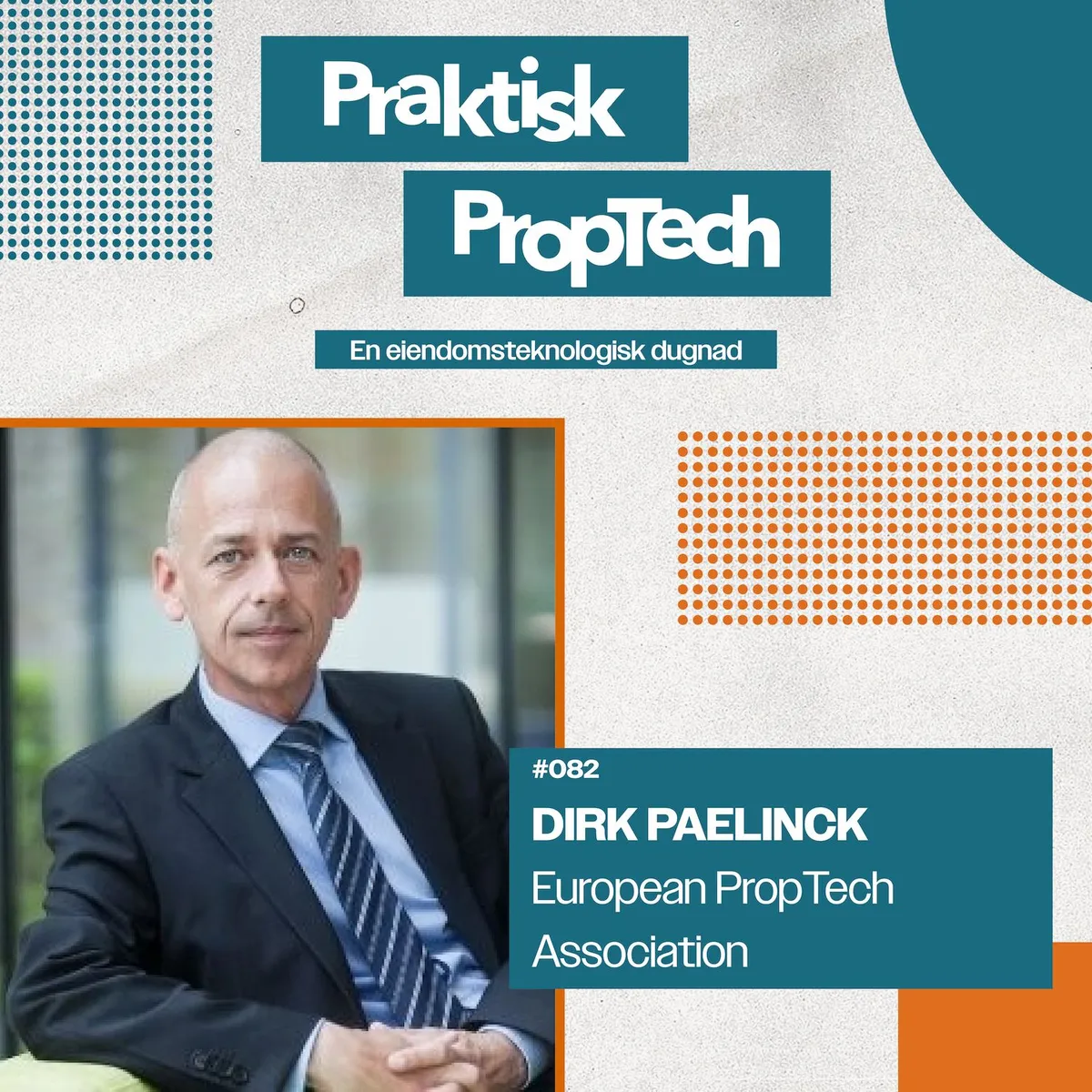
Han sover PropTech. Dirk Paelinck, Chairman of European PropTech Association, og gründeren, faktisk. Så vi kommer til å prate med han nå. Bare for å gi en liten heads up til lytterne: Dette kan fort gå veldig ned i EU-grøten. Mye forkortelser, mye lovgivning, mye abstrakte diskusjoner som foregår, men en realitet vi alle må ta innover oss, for dette kommer til å påvirke oss.
Tommy 01:59
Og det merker vi når vi snakker med Dirk. Det er veldig ofte snakk om ting som vi tenker at dette må jo være langt unna. Men det han snakket om i fjor på PropTech Summit, er allerede realiteten i dag. Og det perspektivet vi skal få med oss nå, det kommer til å være realitet for oss, om det blir om 12 måneder eller 18. Men det kommer.
Martin 02:18
Altså, selv om Dirk sitter tett på EU og EU-parlamentet og EU-kommisjonen, så kommer dette jo også til å påvirke oss gjennom EØS-avtalen og ved å være en del av finansmarkedet i Europa. Så bankene kommer til å sette disse kravene. Gårdeierne kommer til å måtte rapportere på dette her, spesielt når de er over en viss størrelse.
Men jeg tror også det kravet om hvor stor du må være før du må begynne å rapportere i disse nye formatene, begynner å minke og minke og minke. Så til slutt så er det så og si alle som eier næringsbygg, som må begynne å rapportere, og da trenger man også data til å rapportere på dette her. Så la oss få en kontekst fra Dirk. Er du klar?
Tommy 02:59
Ja.
Martin 02:59
Jeg har tatt kaffekoppen min her.
Tommy 03:00
Jeg tar meg en kaffekopp nå, for dette her kommer til å bli intenst og spennende.
Martin 03:04
La oss koble oss på rett fra Brussels, rett fra Belgia og inn i hovedsetet av European PropTech Association.
I heard it’s been a very hectic week for you, and you’re also coming to Oslo next week for the PropTech Summit 2023.
Dirk 03:23
Yeah, this year alone, I think since January, I think I did about 80 keynotes in more than 25 countries.
Martin 03:33
Wow!
Dirk 03:33
Yeah, I went to Dubai, Mexico. So many places where people ask me to come and speak.
Martin 03:40
Wow, well, I think clearly the chairman of the European PropTech Association is someone that’s really sought after in these conferences. So thank you for taking some time with Praktisk PropTech here today. And what I really wanted to discuss is, before PropTech Summit on Wednesday, we will release this episode on Monday. So we’re just a few days away. So kind of contextualize the conference, get that European perspective that’s so unique from you, and also start setting the context for the very special stage on PropTech Summit, the Retrofit Bonanza.
But I think first, Dirk, we need to get to know you. Looking through LinkedIn and talking to, you know, the others from Proptech Norway, getting a sense, I’m starting to get some Elon Musk vibes here, because you’re not only the chairman of the European PropTech Association, but also you have two side jobs as a CEO in two different other companies?
Dirk 04:38
Yes. The one is Interoffices, that’s a co-working business only in Belgium, where we cater to the needs of mostly corporates. I think 90 percent is corporates. Well, we have some entities of the European Commission, but we have also clients like Procter & Gamble, Unilever, Deutsche Telekom, Expedia, Twitter, or X now.
So that is Interoffices. And then the second company I founded is called Workero. It’s a software where we provide solutions for integrated workplace management, also for mostly large clients, in Europe, also in Canada and in Latin America. And then I founded, yeah, well, yes, European PropTech Association, which I’m …
Martin 05:45
Because you were there from the beginning of the European PropTech Association?
Dirk 05:50
Yeah, I founded it. And that is like an umbrella where all the national associations are member. But what we do with European PropTech Association is not that visible, in the sense that the only thing that’s really visible is me doing a lot of keynotes and evangelizing, let’s say, the market, and talking about it. But we mostly work in the background. I work a lot on everything that is legislation. We also work, for example, with European Institute of Technology, European Innovation Council and the European Space Agency, which I will shortly also explain.
So a lot of unique things that we do from the side or also from the legislature, but it’s always concentrated on Europe. And what we do not do is duplicate the activities of the national PropTech association, like, for example, Proptech Norway. So I don’t engage directly with the startups, because the startups, I prefer that they go to the association in their country. So we are more about supporting the whole market and the whole PropTech and construction tech industry by educating people. Because there is a huge lack of knowledge and experience by both the real estate world or the construction industry and the PropTech startups.
And everywhere where I go, I did it also yesterday in Barcelona, I was speaking at the District Summit, which is the real estate event in Barcelona, I always start asking the people: “Who knows what is SFDR? Who knows what is CSRD? Who knows what is ESRS?” And then, I think in a room of 500 people, you have, like, five people who say, “Ah, yes, I know.” So there’s a bit of a disconnect there. There’s a gap in knowledge from what I …
Martin 08:03
What were the three abbreviations? I don’t think I know what they are, actually.
Dirk 08:08
The SFDR was, in fact, the first financial instrument designed by the Commission, quite some years ago, really five or six, and that is called the Sustainable Finance Disclosure Regulation. Which was a way to avoid greenwashing, to go against greenwashing, where any investment and any investment vehicle or fund had to be categorized in three categories, basically.
You have an Article 6 fund, what they call, which is a non-green fund, could be investing in oil, for example. Article 8 fund, that is a fund that is, well, doing green, but it’s not at the core of their activities. And then you have an Article 9, which is like a state-of-the-art investment fund that completely aligns with your taxonomy, with your principles of the EU Green Deal.
Martin 09:05
But the SFDR, how is that related to the EU Taxonomy? Because I think that’s a term that a lot more people in Norway will be familiar with.
Dirk 09:13
Well, the EU Taxonomy is more like a guideline framework that is being used to then derive from that a certain number of legislations. And SFDR was one of the first big steps, because it was a way for the Commission to start controlling and going against greenwashing, which is, by the way, even today, still a huge problem.
You must know that about 80 percent of all publications that you read about ESG, or statements or reportings, is greenwashing. Where we need to distinguish between intended and non-intended greenwashing. Because sometimes companies use a certain way of formulating their activities or their green activities, not knowing that, well, they cannot be doing it in that way. Other ones, they know very, very well that they are not compliant and still advertise as being compliant. So the SFDR was one of those ways to look at them.
Right now, there’s still not many funds that have the status of an Article 9 SFDR fund. A lot of them advertise as being an SFDR Article 9 fund, but they aren’t. So last year, there was a lot of discussion about that, and a lot of those funds, they have received an official notification that they cannot position themselves as an Article 9, but rather an Article 8 fund. It is a complicated matter, let’s be very honest, it’s not easy. But it is a way for the Commission to control how green someone or a company is in its activities, and also to make sure that more and more companies move into the status of Article 9, which is really state-of-the-art. State-of-the-art, let’s be …
Martin 11:26
I think, like, going through all of this EU legislation, I think it’s a great benefit that actually the European PropTech Association is, you know, influencing and managing this, away from the national organizations that are so much more hands-on, so I think …
Tommy 11:40
Yeah, and …
Dirk 11:41
Well, and there’s also another thing to it, just talking about the SFDR. The fact that PropTech startups and scale-ups are not very knowledgeable of it, it creates a barrier for them. Because these regulations are better known by the construction companies or the large real estate funds, of course, because they are financial products. So I was talking about that yesterday in Barcelona, because if you as a PropTech company want to go to the big players in the industry, then you need to learn to talk …
Martin 12:22
Speak the language.
Dirk 12:23
Their language, right? So if I’m in a room with 200 startups, and I ask a question, and there’s two of them who say, “Ah, yes, yes, yes, we really know about that,” then we have a problem. Because, well, first of all, you need to speak the language of the big players, and also if you want to try to convince them that your technology is really what they need, you need to make sure that when they ask you questions, you understand the motive of that question. Why are they asking you certain types of questions? So it’s very important in the way that you position your startup, and also in the way that you will be talking to the people to whom you want to market your product or your services.
Now, SFDR is not the only one. There’s many more legislations. I can talk probably a whole day about this, because they are very detailed. But let’s just say, and I will talk about that also shortly in Oslo, there is what we call the CSRD, which is the Corporate Sustainability Reporting Directive, and that came out the 27th of November of last year, and that is really imposing very, very strict measures on reporting, specifically also for the real estate industry.
And it comes down to a reporting that is as important as the financial reporting. In fact, as from 2025, you will have a financial reporting as a company. That’s the one that you do every year, because you need to do that. It’s about the balances and cash flow. It’s about, you know, the profit and so on. Next to that, you will have the CSRD reporting. That’s your reporting on how sustainable you are in your activities. So this sustainability reporting has now become as important as the financial reporting.
I’m talking Europe, right? I’m talking only Europe. And in the first phase, it applies to more than 50,000 companies in Europe.
Tommy 14:43
But will it be all the countries in Europe, or just some certain countries?
Dirk 14:49
No, no, it’s all over Europe.
Tommy 14:50
All over. Okay.
Martin 14:51
And what’s the threshold? If you say it’s 50,000 companies, how do you know if you’re going to be touched by this CSRD reporting, the new corporate reporting directive?
Dirk 15:00
Well, it’s in three steps, and the three steps follow a certain timeline. So as of 2025, this applies to, well, about 50,000 companies in Europe, and as from a certain revenue or a certain number of people that you employ. So let’s say it very simply, because otherwise we’re gonna get way too technical. The large company …
Martin 15:25
I think some people might also think that, wow, this was quite an intense conversation to have early Saturday morning. But this is really relevant and interesting, and actually a good stark reminder, both for the property companies that listen to the podcast, but also the technology companies.
Dirk 15:41
Yes, yes, absolutely. So let’s take it like this: the reporting standards need to be followed as from 2025 by the large companies, 2026 for the SMEs, mid, large, and then in 2027, it’s even for a company who has only five people as employees, right?
Martin 16:01
Wow!
Dirk 16:01
So it trickles down, and it really goes up to the level of, well, you and me. Let’s say you have a company of 50 people, you also need to apply those same reporting standards.
Now, the last one that I mentioned was the ESRS, and that’s the European Sustainability Reporting …
Martin 16:24
European Sustainability … ESRS.
Dirk 16:27
Yeah, ESRS. And these are standards, right? And these have only been published in their final version four weeks ago.
Martin 16:41
Oh, okay. So this is hot off the press.
Dirk 16:44
Yes, it is hot off the press.
Martin 16:44
So really, the three new acronyms, the three new things that we need to have on our minds now, also in Norwegian PropTech, is SFDR, CSRD and ESRS.
Dirk 16:56
Yes, European …
Martin 16:56
These will be our new friend letters.
Dirk 16:58
Sustainability Reporting Standards. Yes. So in fact, in writing and publishing these standards for reporting, the Commission has established what is ESG reporting in Europe, right? And it has a lot of consequences. But first of all, if you do not comply, you will be fined up to 5 percent of your global revenue.
Martin 17:30
Oh, revenue, not profit?
Dirk 17:32
Revenue.
Tommy 17:33
But for all of the Norwegian companies out there now, when we are at seminars, and not the one that you are speaking in, but like Norwegian seminars, we always hear that the Netherlands is doing that, that these brown buildings will not be rented out anymore. And we always hear that this will come someday. But what you’re saying now is that this is already coming …
Martin 17:59
To Norway.
Tommy 17:59
To Norway.
Dirk 17:59
Yeah, it has been public. Yeah, of course, CSRD was published on the 27th of November of last year, so it’s already known to the general public now since, well, since ten months, right? The ESRS is really recent, but what is important to know is that in a broader sense, this applies to any company that has assets in Europe. Which means that if you are a foreign, a non-EU investor, and you have assets in Europe, then you will need to apply that ESRS standard for the reporting that you need to do within the framework of the CSRD.
Tommy 18:42
Wow!
Dirk 18:43
So it also means that, for example, a US investor, well, he needs to apply that reporting, which is the strictest reporting on ESG that we have on the planet. And in this way, the Commission set the standards for ESG, well, for the world, because it doesn’t exist yet somewhere else. In a way, it’s logical, because the EU Green Deal has always been the most important, let’s say, accomplishment of the president of the Commission, Ursula von der Leyen. The Green Deal in Europe is the toughest on the planet. There is no other continent or country that has a Green Deal that is more strict than the European one.
So all these regulations, what I’m saying is just the most important ones, or the most general ones, let me say it like that. But we have also a lot of other legislation that existed already and that is currently undergoing a complete overhaul, and these legislations are, for example, the ones who define the criteria about the energy efficiency of buildings.
Martin 20:07
And now we get a lot more practical: How does this relate to property owners and people that operate and manage buildings?
Dirk 20:14
Yes, absolutely. Energy obviously is a very, very important one, and that Energy Performance of Buildings Directive is already in place since quite some time, but it’s getting an overhaul. So they are rewriting this at the Commission, and new versions will arrive within one year maximum from now. There are also legislations in preparation about the materials, specifically, for example, for the construction materials. A lot of importance, a lot of attention is going to end of life and beyond the life cycle.
That also is an important one, especially also in retrofit. Because you will need to report on all materials used when you either build new or you do a retrofit. Materials used, and how these materials will affect the planet once you will need to completely demolish the building or refurbish it again in 20 years from now, for example. So it will go as far as that: the moment that you will be asking for a permit to renovate or a permit to build, you will need to already say there: What am I going to do with the materials used in 40 years from now, for example? It depends a bit on the life cycle of the building.
Martin 21:56
So that will have a big impact on the construction of new builds. But one of the focuses for PropTech Summit this year in Oslo is the wave that we predict now of refurbishments and retrofitting the buildings. And some of the kind of alarmist messages we’re getting from Europe, and this is a great perspective you have, Dirk, is, for example, now we’re hearing stories that in the Netherlands, if your building has an energy certification or an energy character below the grade C, it is now illegal to rent it out. Is that a bit of propaganda, or is it true?
Dirk 22:34
No, no, it’s true, and it will come in Belgium, too.
Martin 22:37
Okay.
Dirk 22:37
I think we are on the verge of doing that. Yes, absolutely. Yeah. Now, what is …
Martin 22:43
And do you see that …
Dirk 22:43
Because you speak …
Martin 22:43
So that’s Netherlands, it’s Belgium … Yeah, sorry.
Dirk 22:46
You speak specifically about that. At this moment, we still have a challenge with that in Europe, because when you look at the EPC, it’s handled differently in the different countries. So we should have one European standard defined for all the countries, so that you have an equal playing field in all the countries. Because at this moment, there’s different interpretations of that in the different countries. But …
Martin 23:17
And just, when we say EPC, that’s the Energy Performance Certificate of a building?
Dirk 23:22
Yes, yes.
Martin 23:22
So these are the letters from A to … Does it go all the way down to F?
Dirk 23:26
G.
Tommy 23:26
G. Up to Norway.
Martin 23:28
Up to Norway. So actually, a building in Norway that has an energy certificate C is not the same as one in the Netherlands?
Dirk 23:37
It’s possible. I don’t know that in detail for every country, but I …
Martin 23:40
But you’re saying it’s not standardized? So if you look at one …
Dirk 23:42
It’s not.
Martin 23:42
In one country, it’s not the same as another country?
Dirk 23:44
Yeah. Absolutely.
Tommy 23:44
I think the C is similar to the D in Norway, because we also go down to the F. But with all of this reporting, Dirk, with all of the reporting we have to do, do you see … For the real estate owners out there, what kind of data do they for sure need in the future to be able to report? What’s the most important data?
Dirk 24:06
Well, you need to distinguish between the data that are related to the operations, so energy is one of these, yes. And then otherwise, you need to have the data on the materials that you are using, or, let’s say, the characteristics of the materials that you are using. I might … No, I won’t have the time for that, but on my … on next week. But there is something very, very interesting. I don’t know if you are familiar with a vector that is called the Global Warming Potential of materials. Do you know?
Tommy 24:48
Yeah, but maybe not the listeners.
Martin 24:50
Yeah, I think it’s good to introduce, and something we see often in these EPDs, Environmental Product Declarations, that are coming out, and that’s one of the key metrics that you report on as a supplier to the building industry.
Dirk 25:03
Yes. So in the global warming potential, there’s a very interesting graph about that, where you see all the materials ranked on their global warming potential. And you see that, well, very high is like aluminum and so on. And at the bottom is wood, right? So I think that, in terms of … The GWP is not about the reporting, but it’s a good guideline when you want to renovate or when you want to build new, to look at what are we going to use as material. I don’t say that you need to build all the houses with wood. But you should be looking out also at the new type of materials.
And I think that what we don’t know enough in real estate, in this construction industry, is what are the materials that are right now being investigated, invented, that are still at a low TRL, but that will come out in, I don’t know, three to five years, that have almost zero global warming potential, right? There’s unique new materials that have been designed, and a lot of them thanks to the European Innovation Council initiatives, where the council is funding the research and then really the implementation or test of materials that have zero impact in terms of carbon on the planet, right? We have solutions that, typically, they ask a lot of money, so it means that you need to fund 20, 30, 40 million. And you know that the product will only be on the market, I don’t know …
Martin 27:16
In a few years’ time.
Dirk 27:17
Six years. In eight years. And that is something that is being done by European Innovation Council and also European Institute for Technology, of course, because it’s not happening in the real estate industry. So the real estate industry is not doing that themselves. So we call that …
Martin 27:36
I can see, like, all of these legislations, all of these abbreviations, all of these letters you’ve been saying, all of these processes, might seem for a Norwegian property owner or manager quite heavy, abstract and far away, and maybe it’s tempting to just kind of, okay, close your eyes, nearly. Right, Tommy?
Tommy 27:56
Yeah, and what I’m thinking is, for all of the real estate companies out there, there has to be coming up a lot of PropTech companies trying to solve …
Martin 28:07
Help.
Tommy 28:07
Yeah, help them to solve these, not if we call it problems, but reporting for some of them will feel hard, right? Do you see, traveling all over the world, do you see any PropTech companies coming up to really be the helper that the property companies need?
Dirk 28:23
Yes, yes, absolutely. There are more and more solutions that are being designed to help property owners and construction companies to better report. And that all starts with data, right? So we have quite some software developed where they build on data, and they integrate it in a model where it is linked with, well, reporting standards. Because it’s good to have data, but then you need to make the link with reporting standards. And as you very well know, the lack of data, real-time data, is huge in the industry. Let’s say that most of the building owners, they have no idea of the data that they need for the reporting.
Tommy 29:11
And when you say real-time data, we’re talking, focusing now on existing buildings? Because we think there are going to be a wave of retrofits. Are we talking about then performance data, energy, indoor air quality, technical systems, historical log data, or even data about the materials that were used building the building 10, 20, 30 years ago?
Dirk 29:31
Yes, but let’s make a distinction. The first ones you said, it falls in the category of everything that is operational, right? And there, there’s so many tools that owners can use already now to start collecting those data. The thing is that you need to start using and buying, you know, the software that allows you to do that. Second, if you don’t have them, you need to install enough points where you have sensors to collect this data in a correct way. So that is, for a lot of the property owners, already now a big challenge, right?
But more and more companies, PropTech companies, are designing software specifically to help it, and I’m sure that it’s gonna be a massive industry in the near future. You need to know that in a survey of Bloomberg that was done two months ago, 90 percent of the global companies that they interviewed said that they will increase their spending on ESG reporting tools in 2024.
Tommy 30:52
Wow!
Dirk 30:52
Right? That’s already a sign that all of a sudden, a lot of companies are waking up to the legislation that comes into effect. Because I was talking earlier about the time frame for, for example, the CSRD to kick in. Well, January 2025, all the big companies need to file a reporting. But to do that, you need to collect the data. So they need to start collecting data as from January 2024. So in three months’ time, they need to start collecting data, because otherwise they cannot report on it in 2025.
Tommy 31:31
And so just on Monday, we had this breakfast seminar, actually. And one of the property owners was standing after the event, because Andrew was saying that all of this is happening in the Netherlands, and this is happening all over the place. And at the end of the seminar, he asked us: “Okay, I have five buildings. I don’t have any data on my buildings. I don’t have energy, I don’t have indoor air quality, I don’t have any garbage report. To be compliant, what do I practically have to do today? What do I need to start to do today, so I’m sure that I’m still in business in 2030?” What would your advice for somebody like that be?
Dirk 32:11
Like a small, medium-sized …
Tommy 32:12
Well …
Dirk 32:12
property owner that actually now is very blind for the operational data. What are the … what to prioritize, which data he actually needs to start gathering? Well, the basic is that he needs … Or first of all, he needs a software. Let’s be very honest, he needs a software solution that can gather all the data and present them in a way that can be easily interpreted by those who need to, well, file, the people who need to create the reporting on how green that building is performing. So it means that if he doesn’t have the right sensors or the ways or the tools to measure, he will need to have them installed, right? So first thing …
Tommy 32:58
And let’s be specific about the data, Dirk. So when we say you need to have a software that can report this data, what specific data points?
Dirk 33:06
You need to report on the energy efficiency. Let’s say that that one is a really, really big one, right? And it’s not only about reporting, I will get to that in a minute. So it’s about the air quality, and it’s about anything that is contributing to CO2 emissions. Anything that can have a negative impact on the planet and that is related to your building.
Tommy 33:33
So it’s like a ventilation system, the cooling system, the heating system. You need to have data on all of your technical …
Dirk 33:38
You name anything that is an operational tool that is being used in that building, anything, you need to gather the data and create a reporting from that. But that’s the way of reporting.
Now, the good thing is for an owner, that once you have all this data, you can integrate other tools developed by PropTech companies, where you can act on those data. For example, if you know what is going to be the occupancy per desk or per chair of the four floors in your office building for next Thursday, you can adapt the energy system to that. You can adapt the heating system to that. You can say, “You know what? There’s gonna be 150 people on the first floor, and gonna be 20 people on the second floor for next Thursday. Let’s bring those 20 people of the other floor, let’s bring them to the first floor.”
So you can really intervene in the way the building is operating and start optimizing the use of energy or, for example, the HVAC system. So that is about using those data to optimize the performance or the energy performance, for example, of a building, which is … Currently there are quite some solutions that have come on the market in the last two, three years to help the landlords with that.
Martin 35:17
Can you give … You have quite a unique view, Dirk, of these companies that are coming up and maybe potentially also challenging the traditional enterprise companies that we see within the space. You know, your traditional, like your Schneiders, your Honeywell, your Siemens. What’s really exciting you? Can you name a few companies that really excite you, that help property owners achieve this?
Dirk 35:40
I’ll never do that.
Martin 35:41
Okay. You have no favorite? You can’t?
Dirk 35:44
No, no, I’m really very neutral in that. It’s not my job. That’s something you need to ask to the guys of Proptech Norway, maybe.
Martin 35:53
But we only have the Norwegian perspective, right? So we talked to most of the property companies in Norway.
Dirk 35:57
Well …
Martin 35:57
But what’s really exciting for us, okay, what’s happening in the other markets that we don’t necessarily see?
Dirk 36:02
Yeah. Well, there’s one very simple way, if you want to study that a bit. One of the things that we do with European PropTech Association is we organize the by far largest competition in Europe. It’s called PropTech Startup Europe Awards. It’s for ConTech and PropTech. We did last week the fifth edition of it. It is a competition where there is no monetary prize, so there’s nothing to gain. We have hundreds of companies filing every year, and we have a jury of 70 members, seven zero members, from 24 countries in Europe. They evaluate all the startups and scale-ups that send in their proposals, right?
So it’s a very good way, with the 70 judges, all from real estate industry and from big, big companies. It’s a way, in an objective manner, to say, “Listen, 70 people think that this is a top 50 of new startups in Europe.” And if you go onto my LinkedIn profile, well, I did a post last week or two weeks ago with the top 50. You look into those companies, you will find companies active in exactly the subject that we are talking about. And let’s be honest, when you are in that top 50, it means that 70 people think on average that you’re doing a good job and that you have an exciting product or service. So rather than me telling you who, just look at what 70 people say.
Martin 37:40
Look at that, right. And we were very proud in Norway that there was a Norwegian company that got to the top 10 list.
Dirk 37:45
Yes.
Martin 37:46
And I think that also goes a little bit back to what Carrot is solving, is also linking back to the need to get better data, operational data about your building. So they’re trying to solve this in terms of waste management throughout, on the operation side.
Dirk 38:01
No, no, absolutely, and in a general way of speaking, the Nordics this year were very, very well represented, because almost one third of all the submissions came from the Nordics.
Martin 38:16
Wow! That’s something to be proud about.
Dirk 38:19
But yeah, it’s no secret that the Nordics are producing a lot of good real estate technology companies. It’s not a secret.
Tommy 38:32
If …
Dirk 38:32
Everyone knows it.
Tommy 38:32
If we also look at the … We had some sad news in Norway the last couple of weeks, and that’s property companies going bankrupt and out of business. Do you see in Europe a way, with this increase of rent … We have the economics that is more difficult. We have the … What’s the Norwegian … What’s the English word, Martin, for rente? Interest.
Martin 38:55
Interest rate.
Tommy 38:55
Interest rate.
Martin 38:56
I think what we’re a bit worried about, Dirk: Do you think winter is coming for PropTech?
Dirk 39:02
I think there’s several ways, several elements in my answer. Let’s start to look at the first remark that you gave about going bust. Yes, there’s quite some going bust. Why? But you need to look at it in a larger view. During quite some years, a lot of companies, PropTech companies, have been funded by VCs. About 53 percent of all investment in Europe into PropTech and ConTech came from VC money. And during quite some years, when the interest rates were very low, by the way, those companies have been flooded by a lot of money, and it didn’t matter too much if they were in the red figures or if they were turning, you know, a profit, or even just breaking …
But with what has happened with inflation, war in Ukraine, COVID, of course, because we still have not recovered fully from COVID, the LPs, which means the investors in the VC firms, they were putting the pressure on the VCs and saying: “Listen, I think it’s time that you decide who can stay in the portfolio and who cannot stay there.” So there was a pressure of the VCs in that.
When you look at it as a whole, as a market, in a general way of speaking, for example, this year, the total investment was about 500 million in Q1 2023, where it was 800 million in Q1 of 2022, right? We see also that we have more deals, but smaller deals. We see that the valuation of quite a lot of the public startups is decreasing, right? Now, does it say something about the quality of that company? Not necessarily, but the fact is that there’s more and more questions around that. And then don’t forget that the real estate industry as a whole is in a crisis. It’s really a crisis.
Martin 41:17
Would you call it a crisis already?
Dirk 41:18
I will say …
Martin 41:18
We’ve already come to a stage you would describe …
Dirk 41:20
No, maybe it’s not yet a real crisis in the Nordics, but I can tell you that when you go to Belgium, France, Luxembourg, Holland, even Germany, yeah, we have a lot of challenges there. My good friend, Rudy Aernoudt, is a former chief economist of the European Commission. I invited him in a panel this week, and he quickly calculated the night before that actually, at this moment in Belgium, a bit more than 20 percent of the construction companies are on the verge of bankruptcy.
Martin 41:57
Wow!
Dirk 41:57
Yes. So that’s quite a big chunk of the market. Is it going to be better in 2024? I’m not sure. Nobody knows.
Martin 42:12
But I feel like we touched a little bit upon this new pressure that property owners have now to start this wave of retrofittings, the more stringent requirements in terms of EPCs for your building to be legally allowed to rent them out. The financial markets’ increasing demands through, for example, the taxonomy, to ensure that you lift up the rating of your building, to minimize the risk of a brown discount, to lift it up. Won’t we see a wave of retrofits that we’ve never seen before, driven by these regulatory demands, that will maybe offset what we’ve seen in the decreasing new builds, and instead will try and lift up our existing buildings?
Dirk 43:02
Yeah, absolutely.
Martin 43:03
Or is that wishful thinking?
Dirk 43:04
No, it’s good that you talk about renovation wave, because it’s one of the pillars of the EU Green Deal. You need to know that the renovation wave alone in Europe triggers a cost of about 3 trillion. 3 trillion until 2030, right?
And at the same time, the cost of realizing new sustainable buildings is requiring an investment of 400 billion per year until 2030. So that’s how huge it is. Now, historically, the renovation rate in Europe was between 0.4 percent and 1.2 percent. That’s the renovation rate. In some countries, it was very high. In Germany, it was very high, I think 1.4, and then in other countries, it was, well, really low. 0.4 percent is really low.
So what the Commission decided within the framework of the Green Deal is to say: Well, it’s nice that we have rules for new buildings, and that’s the easiest way to move ahead, but in fact, it’s the existing building stock that is the biggest problem, right? I don’t know if you know this, but 80 percent of the buildings of 2050 have already been built now. That’s a problem. So when …
Martin 44:26
Or an opportunity. It just tells us actually the buildings we have to deal with are already here.
Dirk 44:30
It’s a problem, it’s a challenge. Yeah, absolutely. So that is why this renovation wave was initiated. But at the same time, renovating and retrofitting in the way that is aligned with the EU Green Deal, aligned with taxonomy, is also a way of creating more value for your property. And then, we can be very precise about it. We already know that for 2022, in a general way of speaking, in Europe, there’s a decrease in value of properties of about 20 percent for, let’s say, the non-green properties, to put it very simply. And the top-rated green buildings are seeing an increase in valuation of between 23 and 25 percent, right?
Martin 45:29
So divergence of the bottom, what we refer to as, let’s call them the brown discounted buildings.
Dirk 45:34
Yes.
Martin 45:34
There’s divergence in the value, that is really dropping, and those that have managed to stay ahead for the energy are really flying up in value. They’re getting much more attractive.
Dirk 45:42
Yes. And on top of that, within that framework of the renovation wave, you need money to renovate, right? Okay. So one of the instruments that Europe is using to make sure that the correct reporting is done, and that we allocate the right money to the right projects, is to put the pressure on the banks in Europe. So there’s a huge ESG pressure on the banks in Europe. And the banks will more and more have to ask you how sustainable your project is, if you want to ask there for loans, for example. And this is playing out, I think, also as an advantage of the asset owner who says, “You know what? I’m going for it, and I want to renovate in a way that is aligned with the principles of the Green Deal.” Now, it will come also, most certainly, in Belgium it’s already the case: the greener your project is or your retrofit is, the lower the interest rate that you will be paying.
It’s also very interesting to know that within the whole framework of the big program of NextGen EU, there is a total budget of about 750 billion in Europe that has been made available to all European countries. Now, that money doesn’t go directly to companies or to owners, it goes to the governments of these countries. Now, there’s about 20 categories where a country could ask the Commission, “Okay, I want to have a part of that 750 billion, and I want to use it for that category of activities.” Tourism is one of these, for example, or healthcare. Some countries have more focus on some aspects, right? In Spain and in Portugal, you have a lot of attention or budget asked for tourism, because it’s a very important part of the economy. What is striking is there’s only one category where all the governments have asked money, and that’s construction.
It’s the only category where everyone has asked money. So that already gives you quite an idea of how important this is. Now, that being said, more than, no, less than 50 percent of that money has been handed out already, because not all the plans of all the governments are enough aligned with the principles of the Green Deal. So when I was talking about this cost of the renovation wave, well, there’s money available to help in each country to support the execution, implementation of that renovation wave. But there’s a lot of work still to be done to make sure that we are really renovating in a green way.
Tommy 49:00
But one thing that I’m thinking about is that in Norway, a big percentage of the traditional building owners is family-owned. They have another business, like shipping or something, and they just got a lot of buildings because of the good times, and they invested it. Do you think, lastly, we will see a change in the companies that actually own the buildings? Will it be more of the big core professional ones, or the big VCs that will buy the discounted brown one, make it into a green one? Or do you think we still will have those, let’s call it, unprofessional building owners in the Nordic countries?
Dirk 49:38
They will go out, huh? They will go out of business if they don’t comply, and they have maybe one or two years left. Especially the big ones, they have only two years left. The other ones, maybe four years. But it will come, and you will be so heavily under scrutiny if you have brown assets and you don’t do anything about it. You’re gonna get taxed to death, you can be sure. And there’s a lot of things that will just disappear for you. No access to funding, for example, that will be one of these things. No access to funding anymore.
So in terms of how are we going to finance this, because for me, it’s the most important challenge. You know that the biggest challenge in renovation wave is not a technical one, it’s the financial one. It’s not a technical one, because we have so many smart, intelligent people inventing new materials, inventing new technologies. It’s financing it that is the most difficult one. But as I said, there is quite some money available to do so.
And in the end, you also need to know, and I’m talking now about the younger generation, there’s more than 60 percent of people younger than 30 who are very sensitive to: How sustainable is the building that I’m living in? How sustainable is the building that I’m working in, right? How sustainable is the building that I would like to buy? And in the younger generation, and I think it’s a very, very good sign, they pay increasingly attention to that. And on top of that, there’s a big survey of, I think, four or five months ago in Europe, these people have indicated they are willing to pay 15 percent premium if they can live or work in a building that is sustainable.
And that’s also a positive message, that people are willing to put more of their budget if the building is sustainable. It can be a new building or a retrofit, it doesn’t matter. People are willing to pay more for a product that is more sustainable.
Martin 51:53
More sustainable, also, hopefully, more cost-efficient to operate.
Dirk 51:59
Yes, I think both are going hand in hand, right? And in terms of the operations, of the two challenges, like operational and then the material part, the operational part is a bit easier to solve than purely the …
Martin 52:20
Yeah, because there is much more alignment with the financial incentives to make that the reality.
Dirk 52:28
Yes. Yes, yes.
Martin 52:28
I think, Dirk, there is definitely a lot more conversations to be had about this at PropTech Summit in Oslo. And I think this really sets the frame, the context for our stage, which is going to be … well, has the really exciting name of the Retrofit Bonanza, or this big wave of refurbishments we will see. And so you’re actually opening up our stage in the afternoon at the PropTech Summit, so we’re really excited about that.
And it’s been, for a Saturday morning, guys, this has been a very detailed and very, you know, mind-grappling conversation about all of these bigger picture trends that are coming, a lot driven from Brussels, a lot driven from EU, but we will see impacting also small, medium-sized property owners on the west coast, north of Norway, that need to take this into account. So I must say, from Oslo, thank you very much for joining us, Dirk. That was the end of another episode of Praktisk PropTech. My name is Martin.
Dirk 53:30
My name is Dirk.
Tommy 53:32
And my name is Tommy. And you have just listened to another episode of Praktisk PropTech!
Martin 53:38
Praktisk PropTech.
Tommy 53:39
Fantastic.
Martin 53:39
Yay, the audience go wild. Thank you, Dirk.
Tommy 53:44
Thank you so much.