Tommy 00:00
Velkommen til Praktisk PropTech,
Martin 00:00
med Martin og Tommy.
Tommy 00:00
Dette er en podcast der vi ikke skal snakke om en fremtid langt unna,
Martin 00:00
men hvordan ny teknologi kan hjelpe oss til å drifte,
Tommy 00:00
forvalte
Martin 00:00
og bruke byggene våre i dag.
Tommy 00:00
Vi vil vise deg de beste eksemplene fra innlandet
Martin 00:00
og fra utlandet
Tommy 00:00
om hvordan sensorikk, teknologi og bygg henger sammen.
Martin 00:00
So let’s go!
Intro
Konferansier 00:26
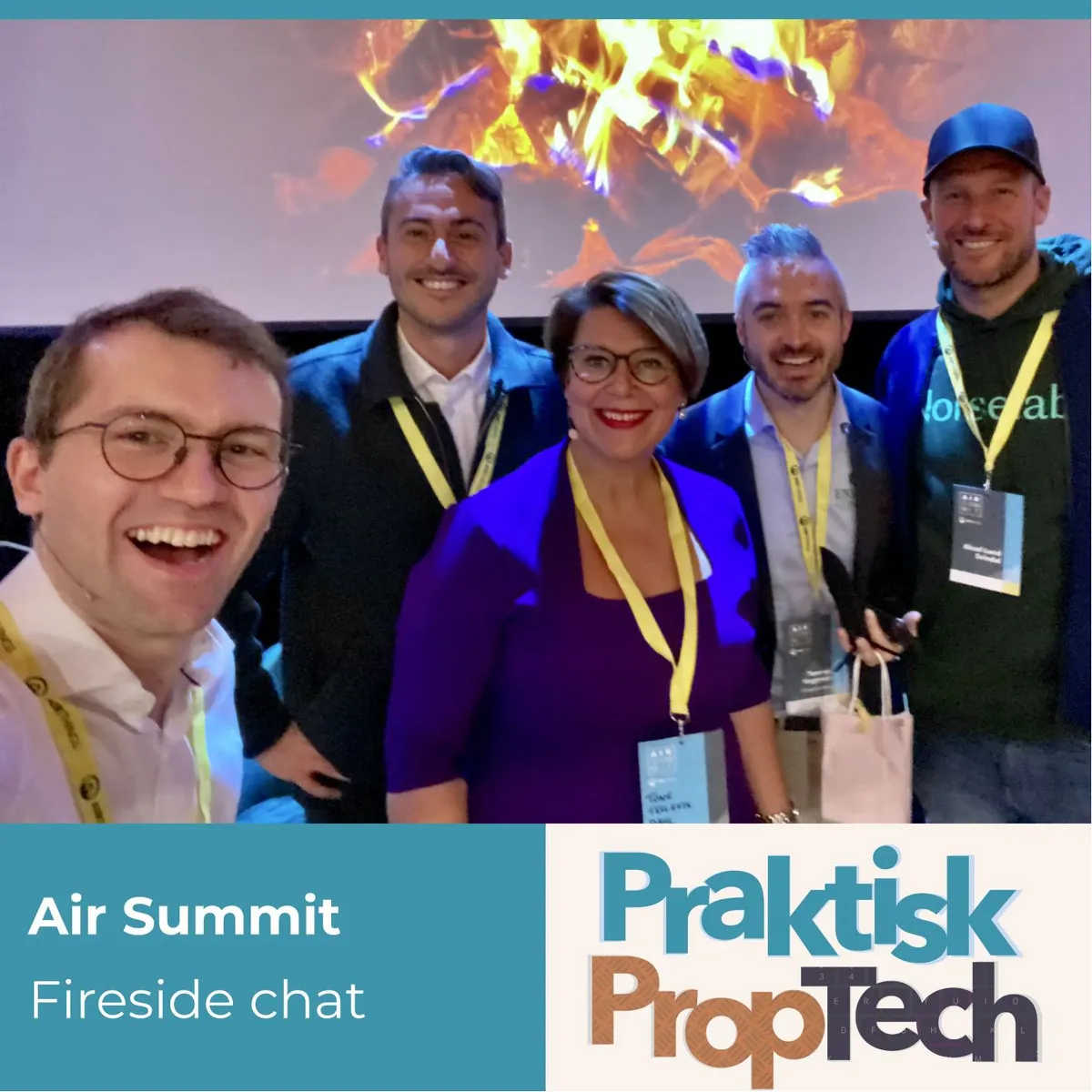
We’re gonna finish off with an exciting panel debate. So I’m gonna bring to stage the participants in this debate. First of all, I wanna introduce Aksel Lund Svindal. He’s a former Norwegian alpine ski racer, famous for his two-time overall World Cup victories. He has two Olympic gold medals, one in Super-G and a legendary one for all Norwegians in downhill. He’s also a five-time world champion. Experienced in building culture after competing at the highest levels for 15 years in sports, Aksel has been a seed investor for more than five years now and joined Airthings’ Board of Directors in 2019.
Also joining the panel debate is Tone Tellevik Dahl. She has since 2020 led Norsk Eiendom, Norwegian Real Estate, which represents over 200 property players across Norway. She has previously also been a leader in academia and in politics. Together with those two, two speakers from earlier today, Eleftherios Zacharakis from the International WELL Building Institute, and Tommy Hagenes from Energy Control, will take part in this debate about balancing health and energy in buildings, and how companies can optimize their energy usage. And also coming back to the stage is Martin McGloin to lead the debate. So enjoy, everyone.
Martin and Tommy is doing a 3D selfie as always (se links)
Martin 02:07
Ooh. Debate sounds very intense. This is meant to be a cozy fireside chat, and I think, guys, before we start, we need to take a selfie. It’s a tradition here, up here now.
Tommy 02:19
The tradition is a 3D model, not a selfie. It’s a 3D model selfie.
Martin 02:23
Oh, you’re going to do a 3D selfie. Can we get the audience with us as well?
Tommy 02:25
I’m gonna top your selfie with a 3D. Are you up for it?
Martin 02:30
Yes! Okay, let’s do a 3D selfie. So actually, what we’ll generate now, Tommy, is a 3D model of the space. This is also one of the tools that you used in Sundvolden Hotel. So you can come back and recreate this moment over and over and over again within the model afterwards. Move around, see everyone’s faces. Ready?
Tommy 02:52
Finish.
Martin 02:52
Oh, you took it already.
Tommy 02:53
Oh, sorry. But we have one more. Sorry.
Paneldeltaker 02:57
We need to get Martin from …
Tommy 02:58
Yeah, yeah, yeah. And this is actually showcasing what we did with Tord in all of the technical rooms.
Martin 03:09
It took …
Tommy 03:09
Sorry, okay, but the last one, we can …
Martin 03:12
Okay, yeah, one more then.
Tommy 03:13
… we have to look like we are having fun.
Martin 03:13
One more. I’ll do my pose. You wanna …
Paneldeltaker 03:19
You wanna sit on your lap?
Martin 03:20
Yeah, yeah. Well, look there then, Tommy. Does that work?
Tommy 03:23
Okay, so everybody, pretend this is very fun and you’re enjoying yourself. One, two, and three.
Martin 03:31
Okay. Wow.
Tommy 03:32
Okay, it’s done.
Martin 03:33
Are we done now?
Tommy 03:33
No, it’s done.
Martin 03:34
Okay. So not a panel discussion, but a way to summarize the day and also narrow in on the key topics we talked about, which was about energy and healthy buildings. But it’s meant to be a fireside, so let’s bring out these chairs, guys. We’ll come a little bit closer, and also, those of you in the back, it’s going to be cold. The fire’s here.
So come on, sit, cozy up. This is an evening in the cabin, maybe an evening at Fyri Hotel. It’s going to be nice and cozy. So come on up here. Oof, this is nice. This is cozy, guys. I’m very, very excited to be sitting with all of you, and I’m sorry that it’s us between you guys and the real bar. So just bear with us now, and then we’ll close the product bar, and we start the cocktail bar.
We’ve covered a lot of different topics today, and I’d like to start with Tone. I think we have a lot of … We have an international audience here today that might not be familiar with Norsk Eiendom. We just made one translation. So maybe a good starting point is, you know, share the work and the important activities that Norsk Eiendom do for the property owners in Norway.
Tone 04:46
Well, it’s an organization for all the real estate companies in Norway, but we also have real estate advisors, like Tommy’s company, who’s a member as well. And we try to work for better regulations for the real estate sector. We try to make our members make good choices concerning ESG. You know, a building is not just only a building for the people working or living in it, but also having a big impact on the surroundings. So we try to make best practice, different kinds of pamphlets and so on. And we also try to enable our members to be a bit more innovative in the ESG …
What are building owners in Norway doing in the energy crises?
Martin 05:43
And I think that’s the key here today as well, right? And a lot of the topics we’ve been covering. We talked about various crises, and I talked to a few members in the audience here during the breaks, and I heard that you were coming, and quite a few of them pointed out that you’re a very good communicator and write some very good articles in Norwegian media to really lift up, you know, the challenge that it is to be a property owner. And how are your members and the property owners in Norway now addressing our current crisis?
Tone 06:10
Well, you know, they are very ready to try to improve the energy efficiency in the buildings, and many of them are already in good shape and having a lot to come. But we need to make this a big scale and to reach the goals in 2030, which is only eight, seven years ahead. We need new politics, and we need also some economic incentives from the politicians. And we see now that Norwegian real estate companies are quite progressive compared with European real estate companies, from my point of view.
But the politicians in EU are more progressive than the Norwegian, and that kind of bugs me a bit, since I was a politician before. So the real estate companies, they want to. We have the knowledge, we have many different tech companies, PropTech companies wanting to give the solutions to our problems. So we can do it, and we want to do it, and we can do it really, really fast. But if we’re going to have more than only the biggest companies, we need help from the politicians.
What is Aksel looking for when investing in new technology companies?
Martin 07:24
And I think one of the themes that we’ve been discussing here today is ensuring we have healthy buildings and energy-efficient buildings, and the solution is a lot within property technology and these new solutions. And one person that’s really made his mark in Norway when it comes to investing and enabling these companies is Aksel, and you’re an investment director in Norselab, one of the leading VCs that’s really focusing now on ESG, and also an investor in several property technology companies.
And when you invest in the companies and look at companies that Tone is talking about as part of the solution for companies, what do you look for? And particularly the companies that you get an extra shining for, and you want to join their boards as well. What’s important for you when you invest?
Aksel 08:08
Ooh, I think, I mean, since we’re sitting here now, and we all have these beautiful Airthings necklaces, I think that’s …
Martin 08:17
You also have Norselab on your tie.
Aksel 08:18
I do.
Martin 08:19
Balance.
Aksel 08:19
But when I want to connect the dots there, because I thought about that when we heard from Sophie, was her name, from Amazon?
Martin 08:27
Mm-hmm.
Aksel 08:27
Yeah. That, you know, what used to be the way that she could get data, which was really nothing. And back when I met Airthings for the first time, it wasn’t Airthings. It was a different name, and it had a much more narrow offering. But what I did learn is the deep, deep knowledge they had on the radon gas. That educated me a lot, and it’s really a parallel to what we see now, because with radon gas, I feel a lot of people don’t want to know if they have it in their home, because then they think their home is worthless.
But the fact is that it’s deadly, and you can actually do something about it. So to not know about it just doesn’t make any sense at all. And it’s a little bit the same now with indoor air quality. If we have horrible air quality, there might be a fairly easy solution, and it’s something we really need to do something about. I mean, there was a quote there about wearing someone else’s clothes. I think it’s more like using someone else’s toothbrush, to be honest. Like, it’s a bit more intrusive than just putting on jackets.
And then, you know, the solution to get regular data through the Corentium back then, that you could actually follow, because it does vary. Radon is not a stable gas. The values aren’t stable. They vary, and right now they’re building Fornebu, so a big subway project out to Fornebu, and I’ve had crazy radon levels when they’re blasting. And they just last for a short while in my basement, and then they’re back to normal again. But still, it just shows the difference.
And what I learned about Airthings back then, like, say the 1.0 Airthings, was something that’s really meaningful. You realize this is something we need, but we just need to open our eyes for it, and then it was real knowledge. It wasn’t just a marketing gig, but it was like: “This is real value to our offer.” And I think that was why I wanted to be a part of it. And then also when you get to know the company … I mean, I got a very good intro, but the intro had no academic knowledge whatsoever. I mean, I have no school, I have no experience, and when you then meet smart people, if I can contribute with something on the board, I can also learn a lot by being on the board. And so it’s kind of a two-way thing where I think I can contribute, but I also do it a little bit for selfish reasons, because I want to learn something as well.
WELL: Why is continuous measuring important for Eleftherios Zacharakis and WELL International?
Martin 11:05
But I think a lot of the companies that you have … So we’re lucky in Norway to have quite a lot of successful property technology companies that are ambitious and wanting to succeed internationally, and that kind of perspective and that ambition, I think it’s clear to the companies you work with that have succeeded. But before you went to that aspect, you talked about the radon monitoring, and the value and importance of continuous monitoring. That brings us back to the beginning of the day. Do you remember that? We had Eleftherios on stage, and he was talking about the WELL Building Standard. And one of the key things that really resonates with me when it comes to WELL certification is this aspect of continuous monitoring.
And as Aksel pointed out, you know, when things change, the values within your building change. Traditionally, how we certify a building is that you take a snapshot, you document at one point in time, and I think a few of us have been into a BREEAM building that should have been excellent, but when it goes into operating and drifting, the energy consumption is not exactly how it was certified. Things change. So tell us a little bit about what’s the role, and why did WELL introduce and bring in this aspect of continuous monitoring in the WELL certification?
Eleftherios 12:17
Exactly. Thank you very much for giving me the opportunity. And as I mentioned before in my speaking session this morning, WELL, what differs from the rest of the certification schemes is that actually you have a third-party verification to verify what you’ve promised, what your goals are, right? Like long term, the life cycle of the buildings, because buildings are used by people, and WELL is for people.
So by being a flexible system, introducing both on-site options, but also pushing to a more smart buildings future, we have introduced the WELL Performance Rating quite recently, back in summer, where with many partners like Airthings, we try ourselves to support the industry to move forward to this more smart building industry, in order to be able, especially after the pandemic, to know how to go back to their buildings and trust them.
What’s Tommy’s key take-away from the Air Summit? How energy and indoor air quality is really connecting!
Martin 13:19
And talking of smart buildings, potentially a smart guy, but definitely someone that works in many smart buildings, is Tommy. What’s been your key takeaway from today? Have you managed to learn something?
Tommy 13:32
A lot, a lot. First of all, there have been phenomenal people on stage today, and I think for me, it’s been like the reddest thread ever, because everybody was contributing to different aspects of the journey. And I think the key takeaway for me is that we know that we need to measure buildings, see how they are used, and then start to do something about the energy.
I think everybody in the room today has talked about occupancy. We are seeing that Friday is the slow day in the office. We see that Sunday is a slow day in the hotel rooms, but we are still using the same amount of energy. So I think that the key takeaway for me is, like, the balance. This kind of balance that Joakim had on his presentation, with balancing between indoor air quality and energy. I think that would be the most important part. I think that in this room, there will be a lot of people changing how we build, maintain, and operate buildings.
Martin 14:29
And I think that there’s probably one dimension missing in Joakim’s graph, because I think it’s a great representation of what we’re trying to achieve here today: how do we maintain the building as a healthy, attractive, productive indoor space with the least amount of energy necessary to achieve that? But there’s a third element, and I’m wondering, I’m opening up to all the panel here now: there’s an ESG element. I think now, when we’re into an energy crisis, everyone’s focusing on reducing our energy costs. But is there a synergy, or is there also a potential contradiction with achieving our ESG goals, our longer-term ESG goals, working towards this?
Tommy 15:08
I can try, or Tone.
Martin 15:09
Tone?
Tone 15:10
Yeah, well, I always believe in synergies, if not, a bit more optimistic. I think this is a great opportunity, actually. Of course, 40 percent of the emissions come from energy in buildings. So of course we have to do something about it, and we have to, like you say, Tommy, we have to monitor it, we have to diversify, and so on and so on. Everybody that can give property owners PropTech that can monitor, and not only one temperature, because remember this, not many women in the audience, but women must have warmer offices than men. So 18 degrees is not working for me or any of my colleagues in my building, well, women. So if you can find a device that kind of, maybe not change your …
Eleftherios 16:05
Do you want to separate again, or what?
Tone 16:08
I don’t know. I don’t know. But maybe some smart people can find something out. I don’t think it’s very easy. But anyway, just remember that the diversity of the people in the working spaces also have different kinds of health and bio. So think about giving us PropTech devices that can measure different important KPIs, that can give us good indoor environment as well. Not only to just justify the working environment act in Norway, because we have many regulations in Norway telling us about how much daylight you should have, what the air quality should be, and so on. Maybe not in the US, but in Norway, it’s quite regulated already. So many of the things in the WELL system are already law regulated in Norway. That’s maybe why WELL isn’t that famous yet, I don’t know.
But I think this is a great opportunity, because we have to think about, not how we use the energy in the buildings, but also how we … What do you call it in English?
Martin 17:20
Try French.
Tone 17:21
Yeah. French is actually better.
Martin 17:23
Yeah, I know.
Tone 17:24
But how you kind of scale and make social zones and everything in the office buildings and so on. We are much more emphasizing these kinds of topics now. Of course, energy, but that’s kind of a technical thing. But how do people …
Martin 17:40
The psychosocial aspects of building?
Tone 17:41
Yeah, the social aspect. How do we work together? Can we sit quiet here for some time? How is the kind of movements in the building? Do I actually meet some colleagues when I go from my working place to the cafeteria, or even if I go to the toilet, is it possible for me to meet other people? Because that is quite important for my health, I think, meeting people. I think everybody through COVID felt that. We need people.
Eleftherios 18:11
I really like the twist this question actually got, and I totally agree. It’s just more than bringing balance between health and energy. As we believe at the International WELL Building Institute, we design WELL to lead and balance both planetary and also human wellbeing. So it’s not just about compromising your experience to energy savings, it’s actually about balancing, as you mentioned, I really like that, and also being inclusive. Inclusive in terms of social sustainability, including the needs of everyone.
What, for example, we’ve seen from the pandemic, based on research by Gartner, is that if you ask the employees how they feel about going back to the office and their preferences, we’ve seen something that they have in common: 70 percent have different opinions, so you can’t actually have only one solution to just squeeze them in. You have to be inclusive and focus actually on ESG, all these aspects.
Martin 19:18
We’ve heard from various property owners today, and hotels have been a new focus area for you, Tommy. But do you know you’re sitting next to a hotel owner?
Tommy 19:29
And that’s where we’re going next. We are …
Martin 19:32
So Aksel, you’ve been through the process of developing, and now also owning, a hotel in Hemsedal, Fyri Hotel. And I think going through … There are certain things you have to do to feel it, but going through that process and getting, you know, first-hand experience of what it takes to get the technical systems of a building to operate as you want, and particularly a hotel is very complex, as Tord will tell you here as well. What did that teach you about, you know, the opportunity and the challenges of property technology?
Why is Aksel “starstruck” by meeting Tommy, and what’s happening in board meetings?
Aksel 20:04
Well, first of all, I’m actually quite excited to meet Tommy, because I never met Tommy, but in every board meeting I’ve been to, if there’s something crazy going on that looks super promising, it usually has Tommy’s name on it. I’m very pleased to finally meet you.
Tommy 20:19
Likewise.
Aksel 20:20
For us, you’re a little bit of a superhero. So thank you.
Tommy 20:23
Like, the crazy part of it.
Aksel 20:25
Yeah.
Tommy 20:25
Not the good part, but the crazy.
Aksel 20:27
Crazy, like, you know, that’s … You have to be …
Tommy 20:28
Crazy good.
Aksel 20:29
No, but if you think … You have to be a little crazy if you think you’re gonna make a real impact, right?
What happened when opening Fyri?
Aksel 20:34
So I think the crazy part is a good part. And when it comes to, of course … So I had very little clue about a lot of the things that were going on, but I tried to sit in a lot of the technical meetings to really understand the process. And it was definitely a … So you remember, you see these documentaries, or not even documentaries, but like shows … They started with Discovery Channel, and now they’re everywhere, about all these people working, and if they’re gonna build a house or if they’re gonna rebuild a car, or if they’re out fishing in the Arctic oceans, it’s super dramatic the whole time, and they don’t make their timelines, and they’re about to die. And you’re watching it, and it’s like: “It must be acting. Like, how bad can it be?” And then you’re opening a hotel.
Like, literally … First of all, people showed up to check in in the morning, which they couldn’t, because we’d said that it was, like, either 12:00 or 1:00, so they had to wait outside. And as the doors open and they come in to check in, people are carrying building materials down the stairs, out the backside. It was a complete mess.
And one of the things that’s the most, I would say, advanced thing to optimize … No, actually, optimize is the wrong word. Just to make work, is the HVAC, the ventilation. Like, how … Even if it’s a brand-new building and someone designed it from scratch, you haven’t, like, built a new part of it or anything and just added it on. It’s thought about from the very first meeting, and still, as you’re opening up, it’s super hard to make it work.
Martin 22:23
In every building.
Aksel 22:24
Exactly, that’s what I learned. Like, it’s … And then I started to think: “Maybe someone didn’t do their job in developing the …” But there’s probably someone here from that industry, and I’m sorry. But it just seems to me, if we talk about artificial intelligence, you don’t need crazy machine learning probably to make that work. You just need the software that can sense what a room feels like, and then you need to open and close some things. It’s not super advanced, but it seems that that industry has a little bit of a lag, because there hasn’t been a lot of focus on it. I mean, that’s a statement, and it’s only my statement, so I’m not trying to bring that on …
Martin 23:02
Many of our members as well have had the same thoughts.
Aksel 23:05
Because it didn’t seem like the most advanced part of the hotel …
Martin 23:08
No.
Aksel 23:08
… but it’s super important. And also for the guests, obviously you want them to come back.
Martin 23:13
Of course. Yeah, yeah.
Aksel 23:13
But now I have a much bigger worry, because now I learned, because we were listening to Sophie, and she said what the air quality was like in submarines. And she didn’t answer, really, but then you had some insight.
Tommy 23:26
Yeah.
Aksel 23:26
And I learned that that’s the worst air quality anywhere. So you have a bunch of people that already are super tense because there’s conflict. They have their thumb on the red button to fire these missiles. And they’re … What was the PPM?
Tommy 23:40
25,000.
Aksel 23:41
25,000. And like, I mean, there’s no way they can think clearly. And …
Tommy 23:44
It’s kind of the same when people build your boiler rooms. There you also have 25,000 PPM, so that’s why it’s not working.
Aksel 23:50
And, I mean, they should put them in a submarine then. Just enough … So that’s my biggest worry right now, actually, is these submarines that are floating or …
Martin 23:58
But maybe the same with submarines, they don’t have enough property technology. But thinking about this challenge you’ve noticed with adoption of … You know, we’ve both come from different industries. You’re from a different industry, I’m from a different industry originally. Tommy’s been here for a long time, but he’s kind of started to see the light, that there is a different way.
Tommy 24:18
Yeah.
What was Martin’s impression when he saw the brand new BMS on a new hotel?
Martin 24:19
Now, why … You know, the first time I went to and saw an SD-anlegg, like a BMS system, and we were actually together in the bottom of Clarion Hotel, which is a brand new … Oh, sorry, I probably shouldn’t say the name of another hotel. But a hotel, a brand new hotel here in Oslo. And the janitor, he was so excited …
Tommy 24:35
Just to narrow it down to what Clarion it was.
Martin 24:38
Which was brand new, brand open. And we got a tour of the janitor’s operations center in the basement, and he was a bit proud and said: “Yeah, I got a new BMS system,” and he wants to show us. And we’re looking around, and said: “It looks like something built in 1995. You know, and you’re proud of this?” And he said: “Oh yeah, but I can access it on my phone!”
And then he’s, like, chucking away and opening up remote desktop, and then he has, like, a big desktop screen, and he zooms in. And said: “Wow, I can have phone access.” You know, what’s the struggle? Like, Tone, Tommy, Aksel, why do you … What’s the hindrance for us to adapt?
Why is it hard to get new technologies into a BMS?
Tommy 25:16
So I …
Martin 25:16
So why is it not as easy to control a building as it is to swipe left on Tinder?
Tommy 25:19
So I have a fun fact first.
Martin 25:21
Okay.
Tommy 25:21
You know, like, if you’re building a brand new hotel, and you’re probably using Modbus, that’s the protocol, which year was Modbus made? 1977. So when did …
Martin 25:33
Wait, sorry, sorry.
Tommy 25:34
Huh?
Martin 25:34
You did say this was … I … You said a fun fact.
Tommy 25:37
Yeah, yeah, 1977.
Martin 25:39
Wow!
Tommy 25:42
And when did we get internet?
Tone 25:45
’93?
Tommy 25:46
Yeah. And then when was it commercially used, like Windows 95, that was the big step, right?
Martin 25:51
I think it came in 1995.
Tommy 25:52
Yeah, 1995. It was the commercial use of internet. You had it before, but the commercial use. So this was, like, 22 years even before we were using PCs, and we’re still using the same protocols, and that’s actually why it’s hard. I got the question earlier: “Why is it hard to control these kinds of buildings?” And I think we are trying to do that in our podcast as well. We’re trying to say that it’s prop and tech. It’s two different worlds.
So when we actually are using Airthings to control a building, we still need to have a box talking to a protocol from 1977. There isn’t any security. If I ask: “Who is there?” Every dumb sensor will answer: “I’m here, I’m here, I’m here, I’m here.”
Martin 26:35
“Hack me, hack me!”
Tommy 26:36
“Please hack me.”
Martin 26:37
Yeah.
Tommy 26:37
So it’s like … it’s two completely different worlds.
Martin 26:41
But then, okay, but why … What’s the reluctance to adopt new? Like, we have MQTT. Okay, this is getting a bit geeky. Sorry, Tone.
Tommy 26:49
But no one …
Martin 26:50
No, it’s …
Aksel 26:50
… excited about it, that’s the two of you, so. Leaving it up.
Martin 26:55
But within Norsk Eiendom, like, what do you think is the hindrance? Like, why?
Tone 26:59
It is the confidence, because the tech thing has been kind of strange. There are some other people doing that. We are building buildings, you know, with steel and concrete and everything. And of course, the digitalization is improving, but we have many, many steps to go. And I think if you don’t have a good building owner or a project leader, you can actually ask for different PropTech things: “Can you … give you the problem, can you solve this?” And have an open mind.
So we try, as an organization, to tell our members: “Be open-minded. Focus on the problems that you want to solve, and that is climate, that is social interaction, whatever it is, and give the problems out there and try to be bold. Maybe someone will actually surprise you and give you what you need.” But of course, sometimes it’s hard to be the first mover, but we try to push and say: “If you’re the first mover, I will do my work and go to the politicians and say: ‘You have to change the regulation so we can do this and that.’” But, yeah, I don’t know.
Aksel 28:14
But I think we can be a bit optimistic, because you said something earlier about the politicians being fairly slow.
Tone 28:22
In Norway, yeah.
Aksel 28:22
But we do have a lot of private real estate companies that go forward even if they’re not required to.
Tone 28:30
No, because we actually …
Aksel 28:32
But I think …
Tone 28:32
… ask: “Can you …”
Aksel 28:32
No, but in that, there is, I think, something valuable here, is that the people that actually know the most about the real estate …
Tone 28:40
Yeah. We don’t wait.
Aksel 28:42
… they move faster than the people who are supposed to protect our health, in a sense.
Tone 28:46
That’s right.
Aksel 28:47
So, I mean, there is something positive there that we can hold on to, because they have the chance to do something tomorrow when you do own the building, right?
Tone 28:53
That’s right.
Aksel 28:53
And politics is never two plus two equals four. It’s always some other number that you can’t really understand. And I think in that, there’s something very positive there. They haven’t been told to do so.
Tone 29:07
No.
Aksel 29:07
They do so on their own initiative.
Tone 29:09
Yes, and we don’t sit and wait for the politicians. Don’t think wrong of what I said. We don’t wait, but we need to scale up. But there’s still a lot of money in real estate, and that gives us the possibility in Norway, I think, to be as progressive as I think the Norwegian real estate family is, compared to European real estate companies.
What should the government do to help building owners learn about new technologies?
Martin 29:35
But we’re not necessarily getting medvind, in Norwegian. Oh, I’m struggling with the English here now.
Aksel 29:41
Tailwind.
Martin 29:42
Tailwind from the politicians either.
Aksel 29:43
Aren’t you?
Martin 29:43
Like, the latest article you wrote for Aftenposten focused on how maybe the government isn’t quite understanding the unique structure and nature of the property sector to be able to help them to adopt new technology, and probably actually more hindering it.
Tone 30:01
Yeah, because they have a lot of focus on the tenants. Of course, we need to hinder bankruptcy and people losing their jobs, of course, in different companies, but it is the building owner that has the capacity and the possibility to actually do something about the energy system in the building that actually will benefit the tenants, the bakery or the retail shop or whatever. But the politicians actually don’t see the connections.
So I try to tell them: “You have to put the incentives towards the building owners. They can do it.” And with good help from the PropTech business, we can actually move very, very fast. It takes ten years to build one windmill outside my home base in western Norway. It takes two or three years, actually, to save 16 terawatt hours in the Norwegian buildings, the company office buildings in Norway, if we get a bit of help. We want …
Martin 31:13
I recommend reading the kronikk, another word I can’t translate on the standing foot now. But for those of you that speak Norwegian, this is a great motivation to read it. That was in Aftenposten a few days ago. And if you don’t speak Norwegian, definitely a motivation to learn Norwegian to read Tone’s article.
Because what you point out is that the governmental support for property owners in Norway now, they don’t understand this fragmentation, which I also think is a challenge with property technology adoption: we have an owner, a developer, and a tenant, and their interests are not necessarily always aligned in who invests, who operates, and who gets the value of property technology. In the same way, the government is not necessarily seeing this in how they provide support for us to adopt technology to save energy.
What can the Nordic property sector teach the rest of the world?
Martin 31:57
But let’s be positive at the end, because the bar is opening. I’m hearing the cocktail shaker. I’m going to go and have my whiskey. So we’re in the Nordics. Even though you’re Greek, you’ve also been based in Sweden for many years. We have some great examples of Norwegians here with us as well. What can the Nordic property sector teach the rest of the world? Do we have something we can be particularly proud of? Do we have something different that actually can set an example internationally as well, something that we can be proud of?
Eleftherios 32:30
Definitely. From my experience working in the Nordics, with the Scandinavian countries of Norway, Sweden, Denmark, Finland, and Iceland, what we’ve actually seen compared to the rest of the world, and especially continental Europe, we’ve seen, like, three aspects that the Scandinavian countries actually have something to teach the others. So the first one is the way that the Scandinavian countries have been promoting urbanization. We all know that in the following years, most of the people are actually gonna be living in cities. In the Nordics, it has been a bit late compared to other European cities, big cities, and so on.
But due to the pure nature and environment of Scandinavia, the way that business is being done, and the way that the state helps with startups and innovations, having actually the Nordic countries ranking in the top 10 every year when it comes to the Global Innovation Index, is something that we see help each other. So urbanization, the real estate sector, is still continuing to thrive. The startups in the tech sector are growing and have good incentives from the state.
And also the pure nature from the Scandinavians and the local green building councils that work with sustainability create this forum to foster collaboration. I think that’s very important to teach and reach out with this message to the rest of the world. I know the Scandinavians are a bit modest, and they don’t really like to talk about this, but that’s something that I believe the rest of the world can actually really, really learn: collaboration.
Martin 34:19
And Tommy, I know that we get so frustrated at the adoption of digitization and property technology in Norway, it’s so slow, but we’re actually leading.
Tommy 34:27
Yeah. I think Norway is in second place in most succeeding PropTech companies, and Sweden is just before us. So Nordic countries are doing it good. We will win.
But the other thing is, if you look historically back, we had very low energy prices. And also, if we can produce products in Norway, and we can actually make that a … You will take the cost for it. If we can make it here, we can make it anywhere, and I think that’s, like, one of the best things. When we make something in Norway, we see that it scales out there.
So, but if you look at the negative side of it, in the Nordic countries, we are very digital. Like, we have Elhub, which is a place where you can collect all the energy data of every building. We have Nord Pool with the power prices. We have the Meteorological Institute for outside air temperature. There is so much open data, so it’s so easy for startup companies to actually produce an app on top of it. Like, for Airthings, to get all of the outdoor data, and it’s just a software thing. So we are a bit lucky in Norway to be so digitalized. I think that’s one problem that we are seeing when people go from Norway outside: you are missing some of those advantages, or you’re thinking like: “Oh, so people don’t even have BankID,” like the digitalization of having a legitimering?
Aksel 35:46
ID.
Tommy 35:47
ID. Thank you.
Martin 35:47
I like how everyone looks to Aksel when we need a translation.
Tommy 35:50
He’s my expert now.
Martin 35:54
Do you have, you know, anything else from the technology or property side in Norway that we can be proud of? Do we have the winner instinct?
Aksel 36:02
I mean, I think we’re not afraid to take some risk, and if you’re gonna be a first mover, you have to take some risk. So I think that’s a good start. But I do agree on the … But I see it as a positive, like you said it as a challenge, that there is less access to data, but if you look on the flip side, it’s also a reason why we can be a first mover, right? So you can do things that in other countries are very hard because they don’t have the data.
And, I mean, I think that’s just something that we should … I mean, we’re lucky to live here in many ways. And then I think we can afford to take some risk, and we can be first mover, and even if something fails, then we kind of, you know, we’re in that position where we can always try again. So I think we should use that to our advantage, and …
Martin 36:55
We have a head start, kind of.
Aksel 36:57
I think we have a head start, but also, I think we also have to acknowledge that we’re lucky to live in a country where most things are taken care of. So then you also, you know, you can add some risk to that and maybe go down a path that’s not 100 percent safe. But if you do succeed, there is benefit in it for more than just yourself, but for more people.
Martin 37:18
Wow. Finally, Tone, do you have any reflections on this?
Tone 37:21
No, I totally agree with the rest of the panel. And I think we are in a very good position to reach the quite ambitious goals for 2030 and even 2050, concerning, of course, the green gas, but also the rest of the syllabus, the ESG.
Martin 37:44
So you’re optimistic on Norwegian practice?
Tone 37:47
I think we can do it. And if everybody uses the possibilities in real estate to achieve these goals, we can actually achieve the UN goals as well.
Martin 38:01
Very good. Let’s leave it at a positive, hopeful note. The bar is opening. Thank you very much to the panel. Thank you very much for joining us here in Sentralen today.